Skip to content

Diabetes Amigo

Supporting the parents and caregivers of kids diagnosed with Type 1 Diabetes

  • Daily T1D
    • Daily Diabetes Kit/Bag
    • Insulin Storage
  • CGM
  • Insulin Pumps
  • Easing MDI Injections
  • Carb Counting
  • Travel
  • Sports
  • Home
  • Blog
  • Day-to-Day T1D

Category: Day-to-Day T1D

Swimming and T1D Type 1 Diabetes

Posted on May 31, 2023June 10, 2023 By Diabetes Amigo
Swimming and T1D Type 1 Diabetes
Day-to-Day T1D

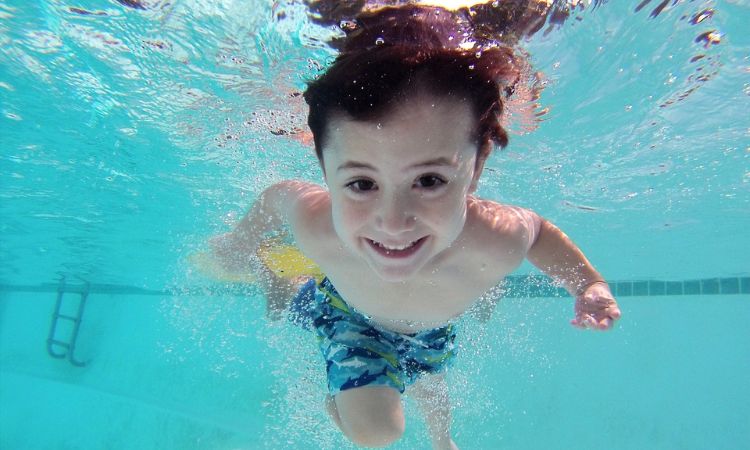
Pool days and swimming require special considerations for Type 1 Diabetics. Have a relaxing and manageable day swimming at the pool with the right preparations for managing Type 1 Diabetes (medical devices [pumps and CGMs] and blood sugars).

Supplies / Insulin / BGs / Hot Tubs / Swimwear / Sunscreen

This post may contain affiliate links. Please see the affiliate disclosure for more details.

Supplies

We have a compact daily supply bag that holds all our Type 1 Diabetes (T1D) supplies. The supply bag is compact and convenient when accessing supplies. For pool days, consider additionally bringing the following supplies:

  • Extra CGM (Dexcom or Libre) sensor and transmitter – just in case the entire device is lost in the water, a back up might be needed.
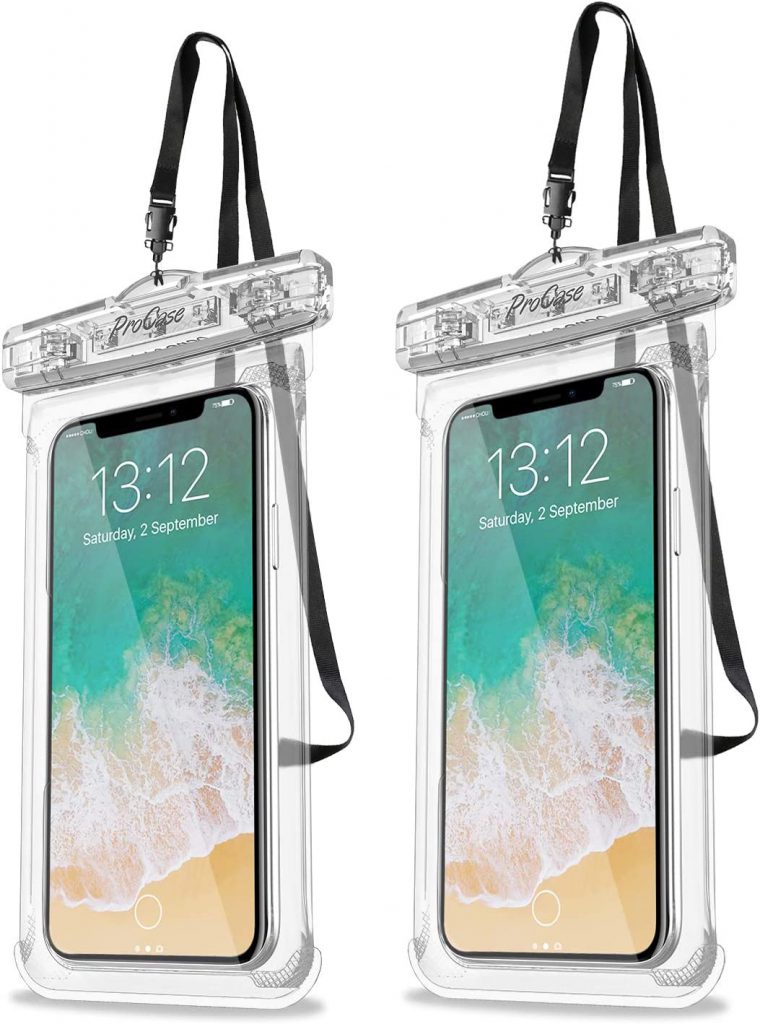
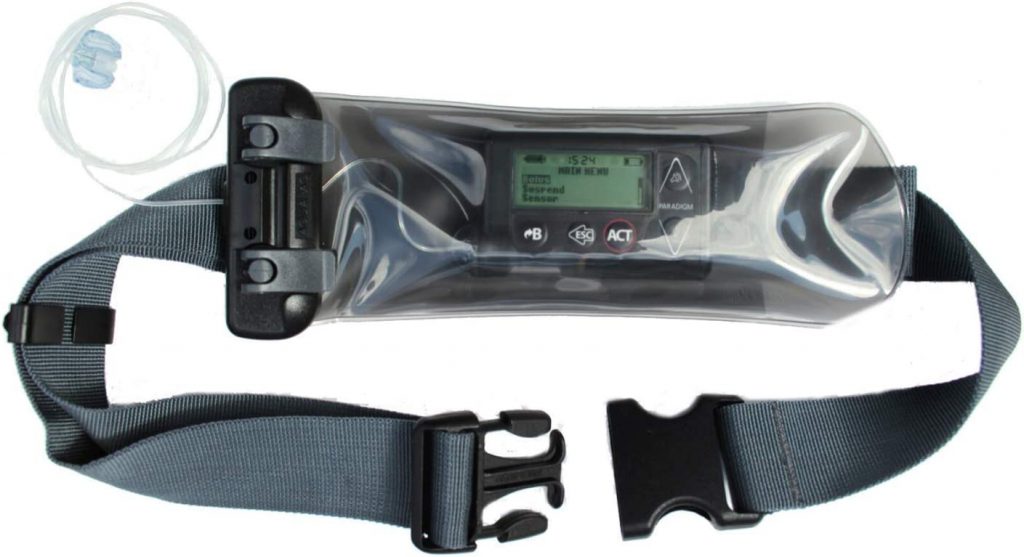
  • Waterproof Cases – consider keeping receivers, phones, pump controllers, and pumps (disconnected or connected) in waterproof cases.
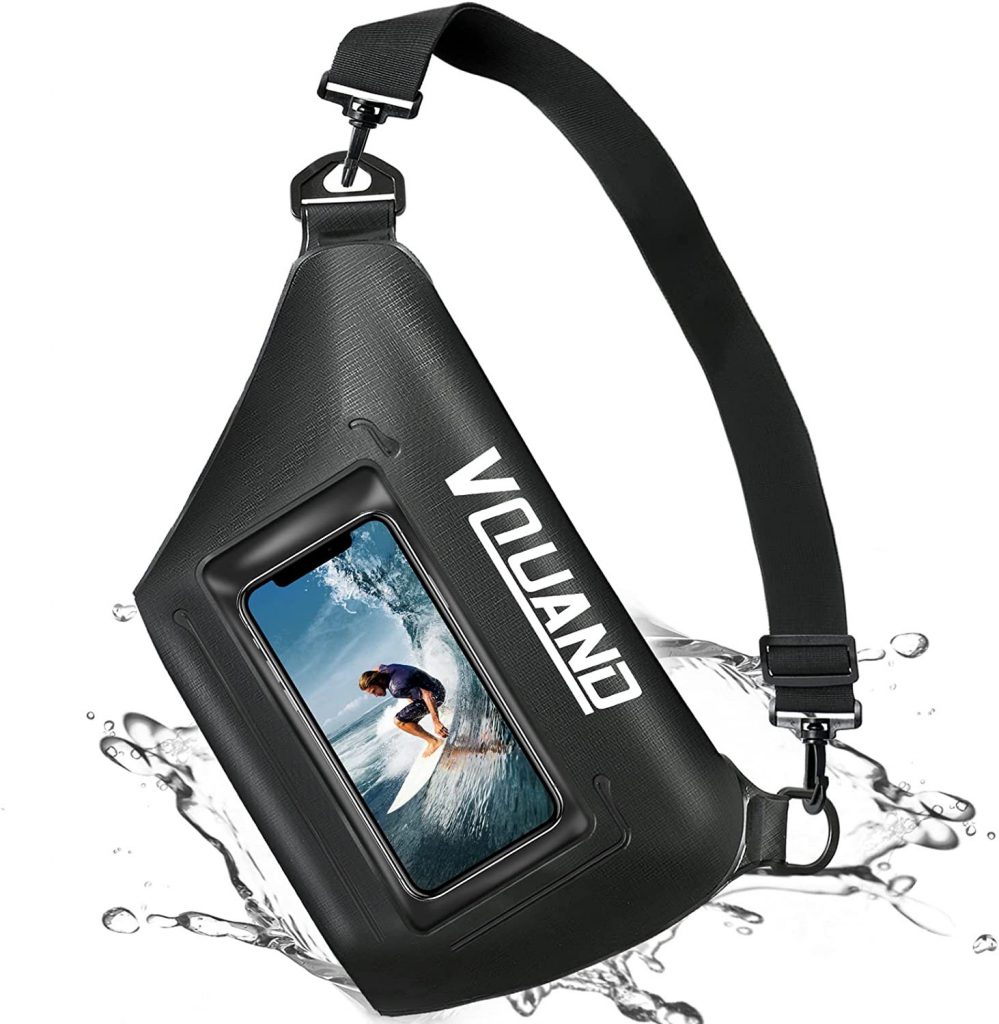
Waterproof Fanny Pack
Waterproof Phone Case
Waterproof Pump Belt that Allows for Tubing
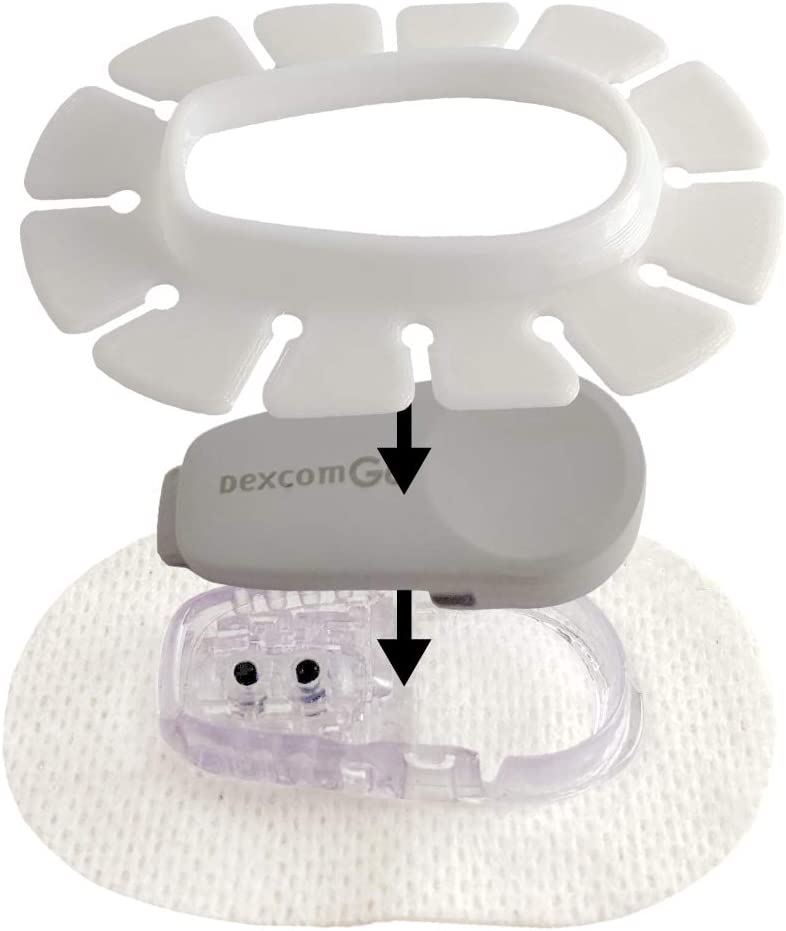
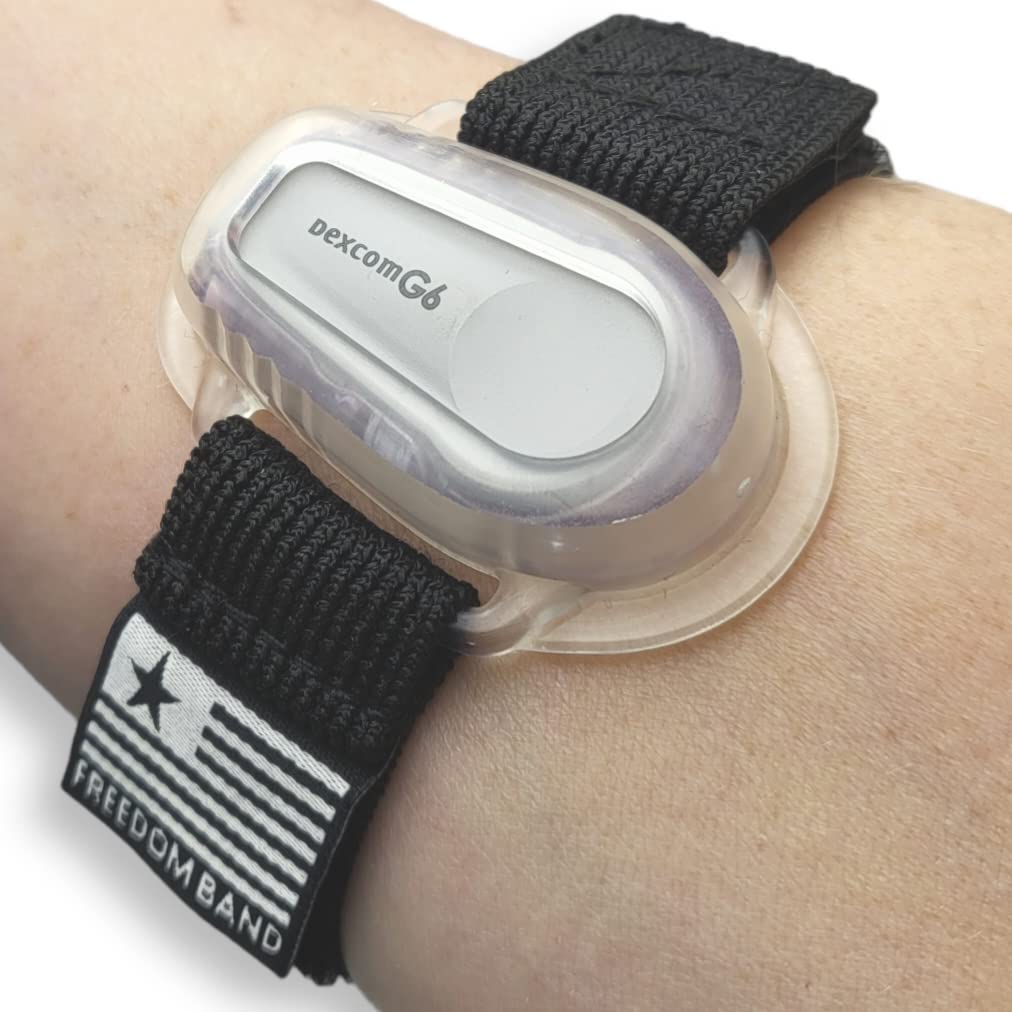
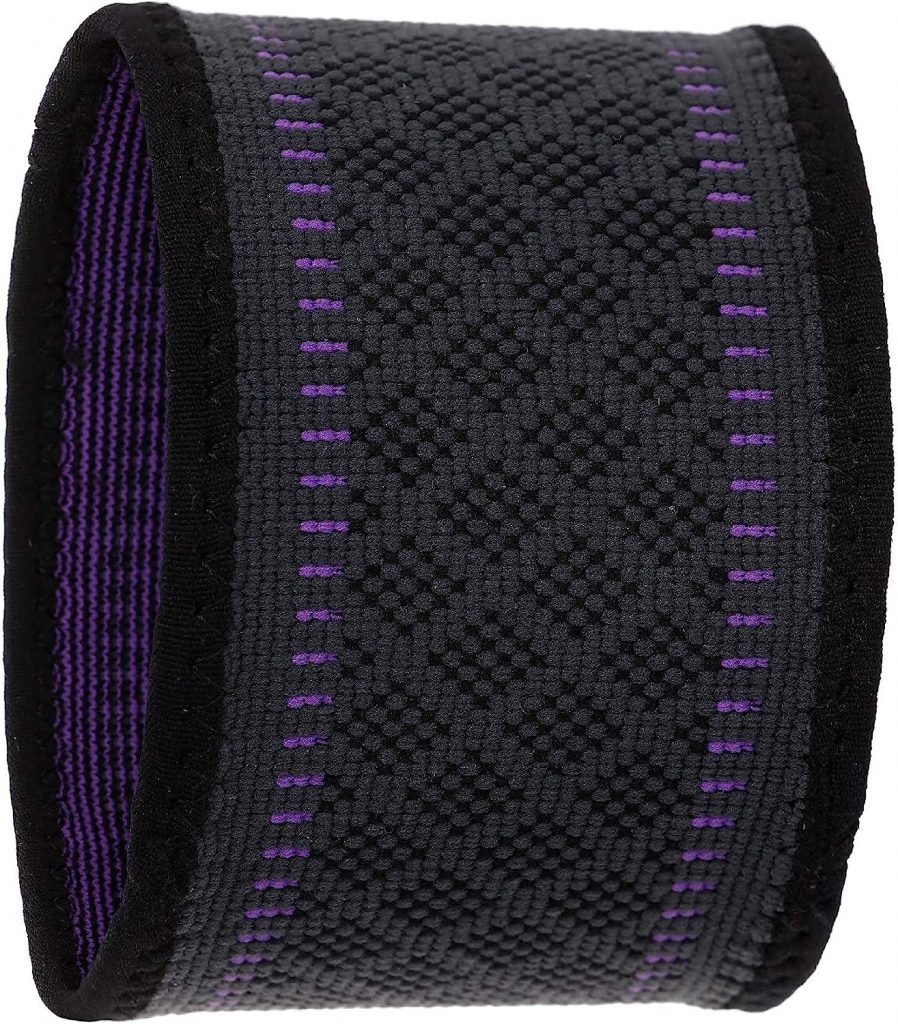
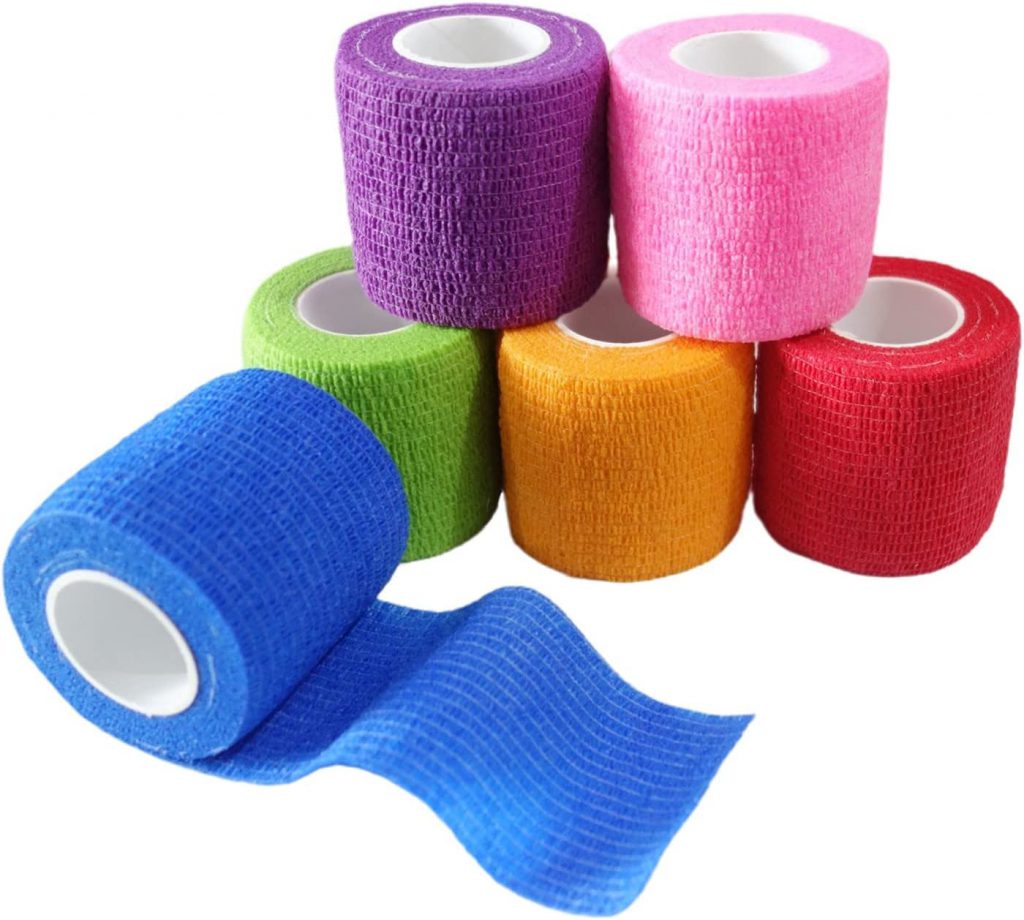
  • Extra Protection for the CGM and Pump – options include overpatches, CGM shield, armbands and/or vet wrap. Giving the medical devices extra help to stay on during hours of being submerged in water helps.
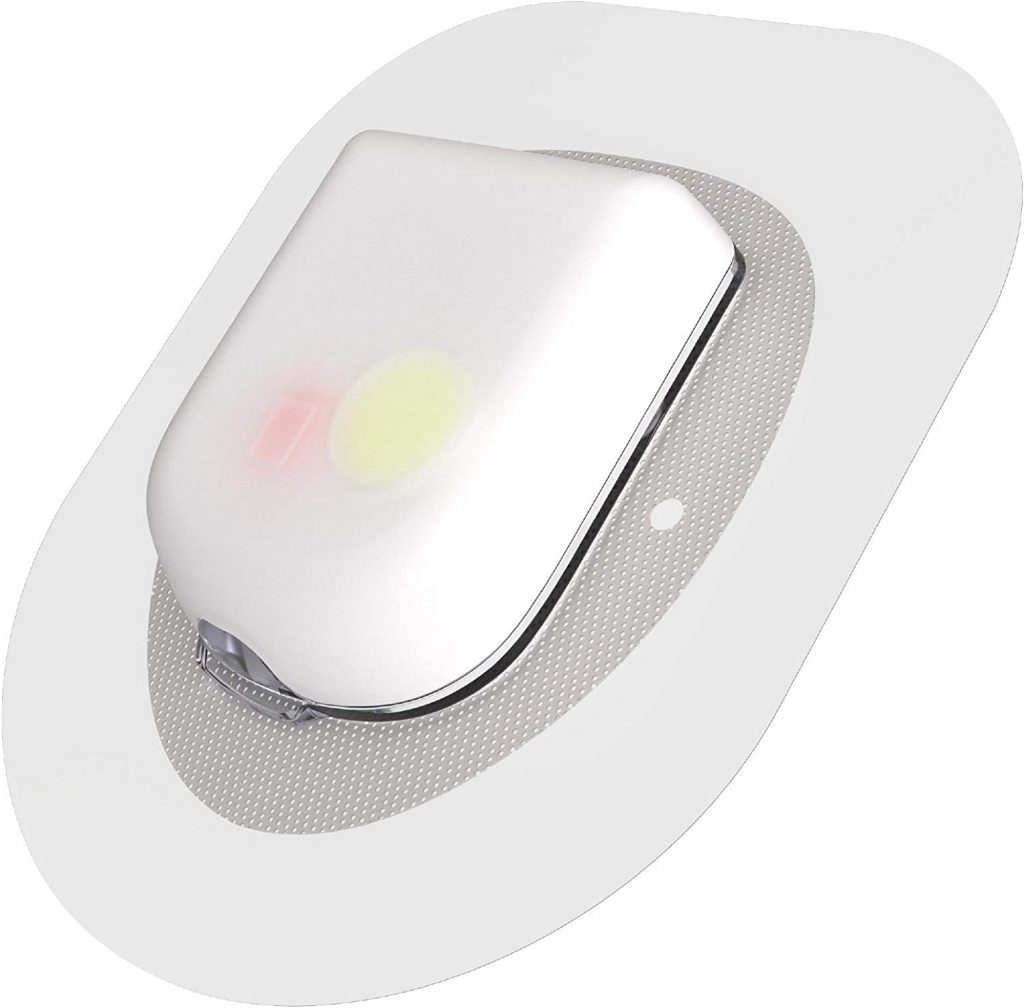
Overpatches
Shield
Armband
Compression Arm Band
Vet Wrap
  • Travel BG Checking Supplies – CGMs do not send blood glucose data to receivers or phones while swimming underwater. Getting the CGM and phone to reconnect can take up to 15 minutes once out of the water. In the absence of CGM data, we manually test blood sugars every 30 minutes. Consider keeping a small bag that only holds lancer, lancets, blood glucose test strips, the meter and low supplies for easy access. This helps to keep all other supplies dry and manual BG supplies easily accessible.
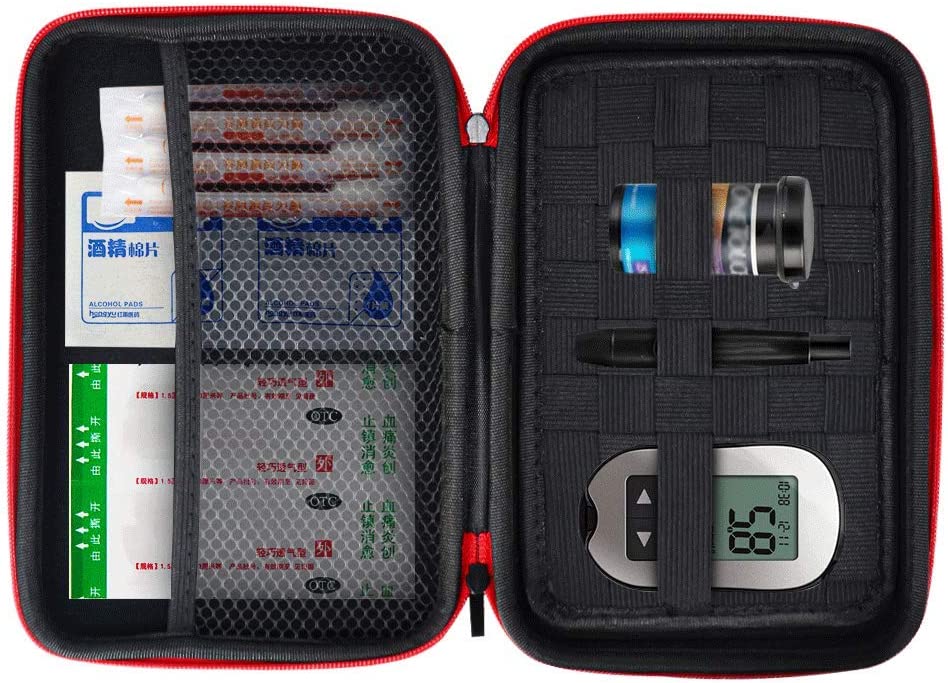
Blood Sugar Management Supply Case
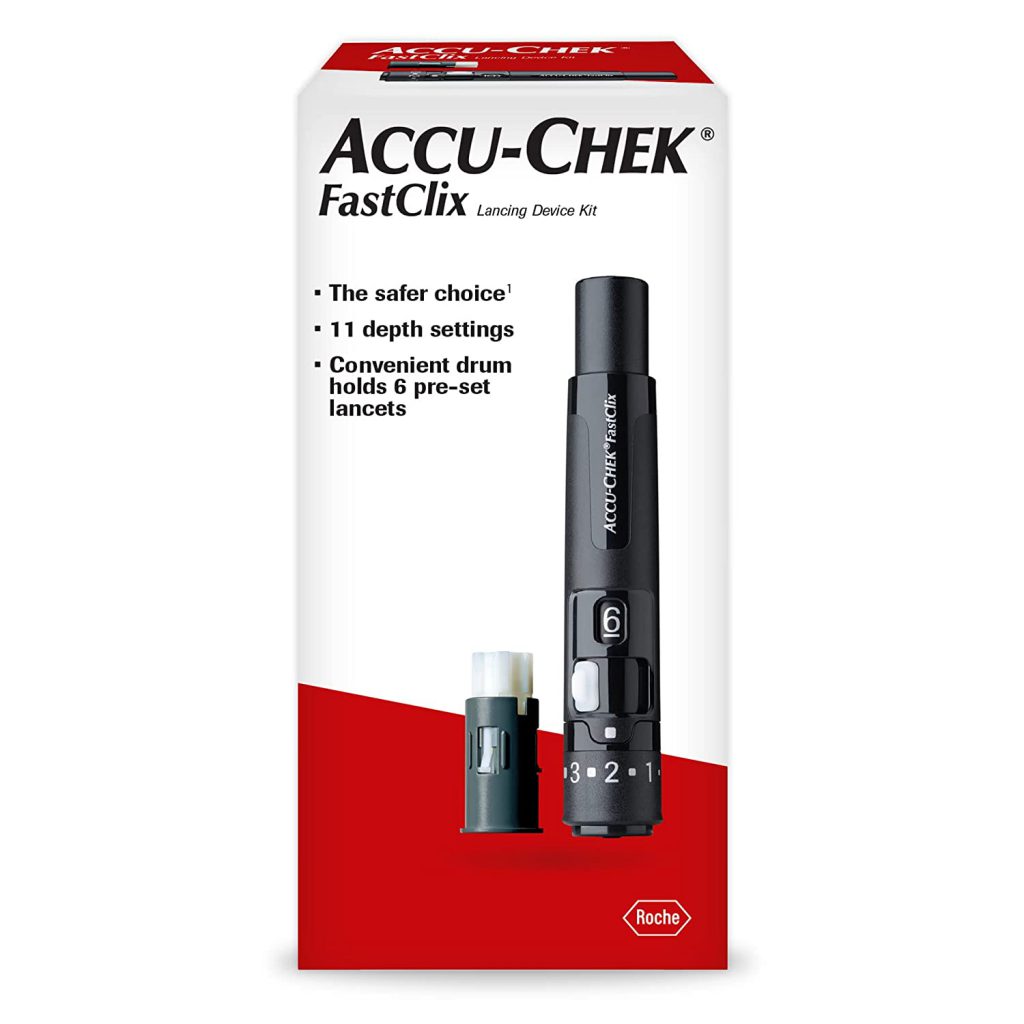
Lancer
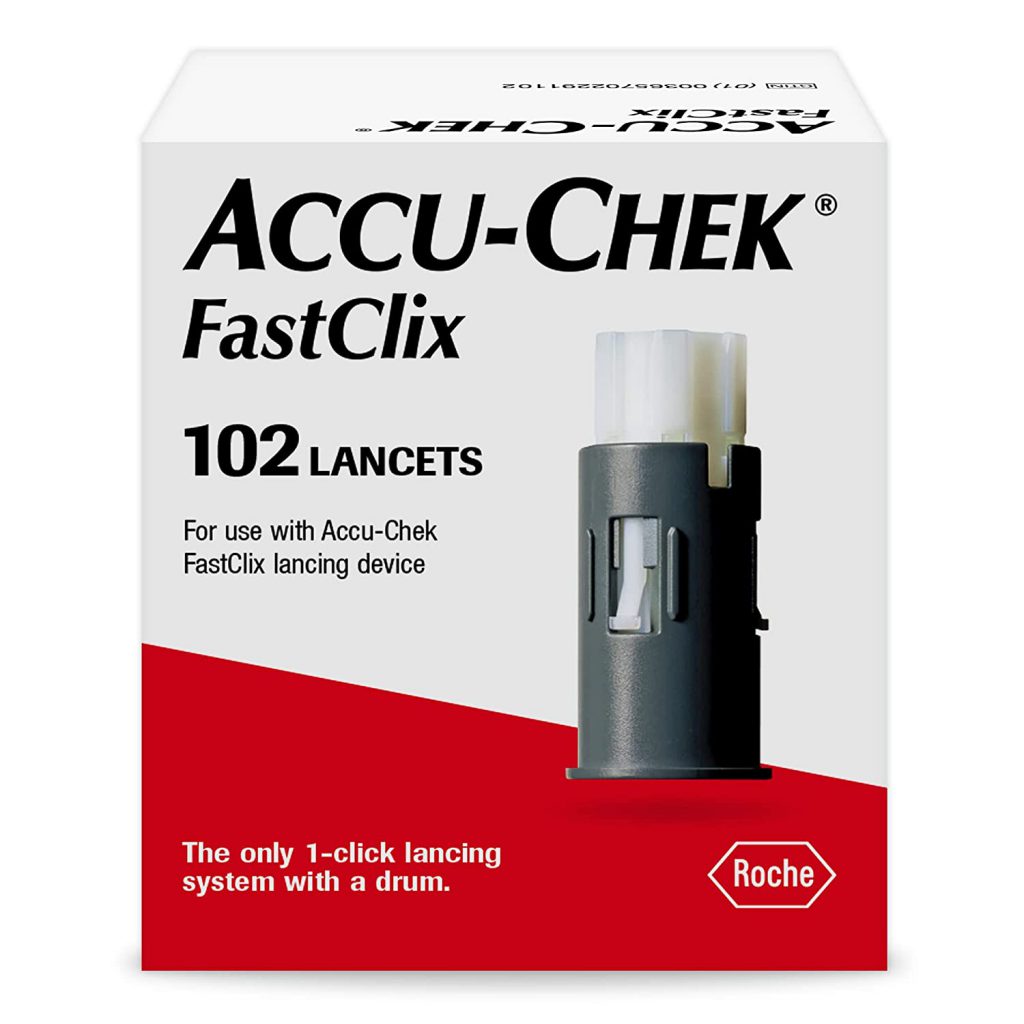
Lancets
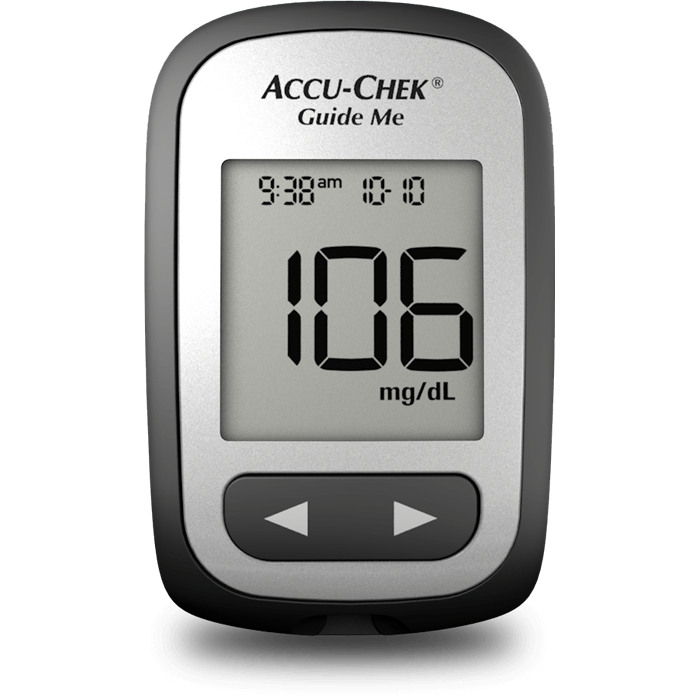
Free BG Meter
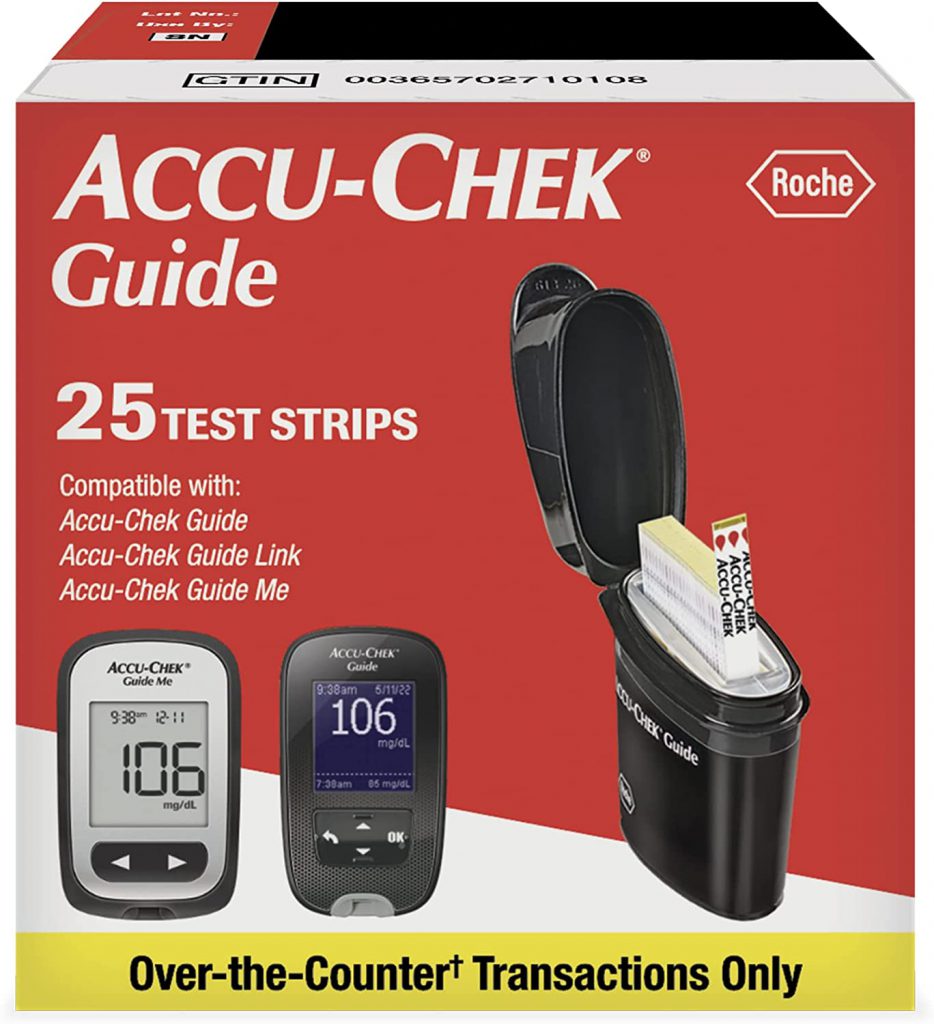
Test Strips

Insulin

Consider keeping the daily supply bag containing insulin pens or vials out of direct sun exposure. Simply keep the supply bag under your pool seat for shade to keep insulin from getting too hot. If you are concerned about insulin in the shade, here a few tips for keeping insulin at the right temperature:

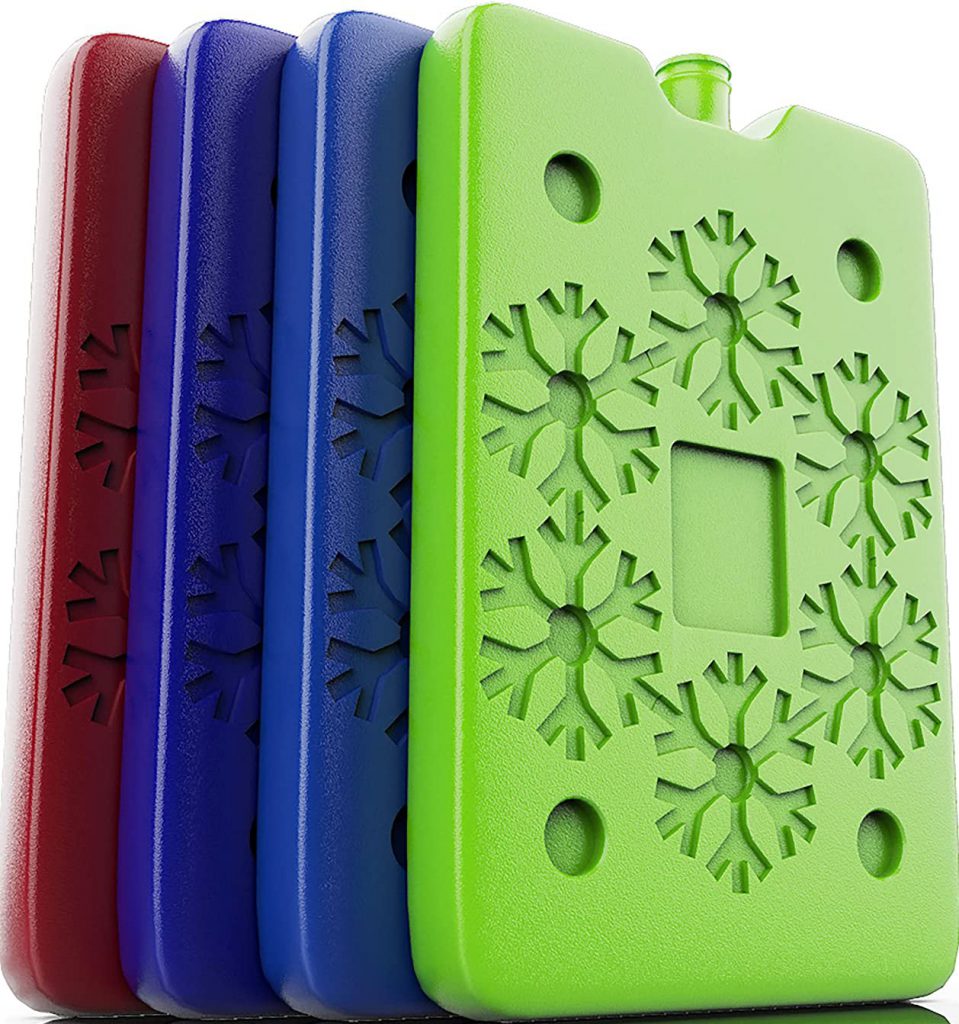
  • Lockers – public pools typically have lockers that can get hot (typically a metal box that heats up in both indoor and outdoor pools). Keep supplies cool with ice packs or look for lockers in the shade.
  • Frio Wallet – a Frio Wallet will help keep insulin vials and pens cool and does not require a fridge/freezer to activate.
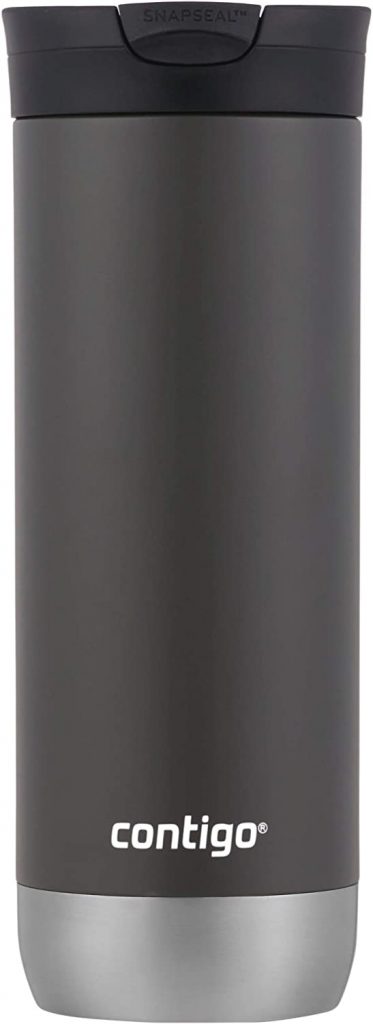
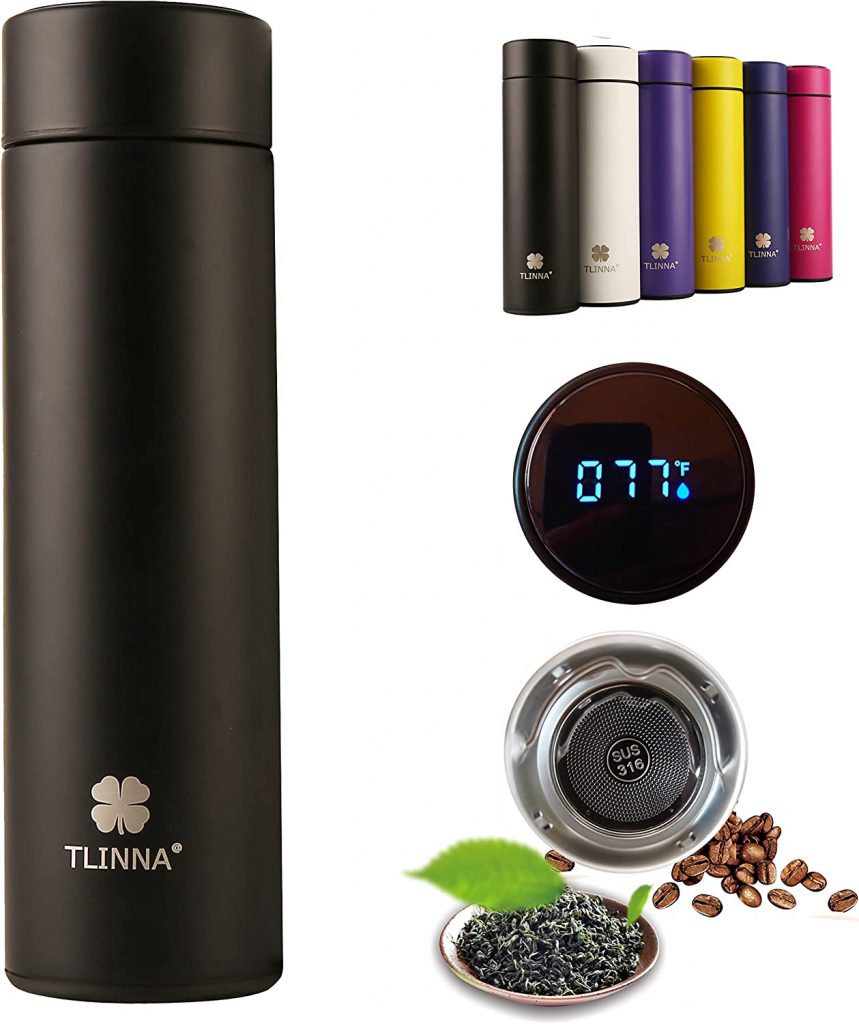
  • Insulated Bottle – add ice to an insulated bottle, wrap your insulin pen/vial in a paper towel or Frio bag (adds insulation so the insulin is not directly in freezing water, if the ice melts), place the wrapped insulin pen/vial in sandwich bag and secure with the bottle’s lid. A coffee travel mug works well because of the wide mouth design (any insulted water bottle works though).
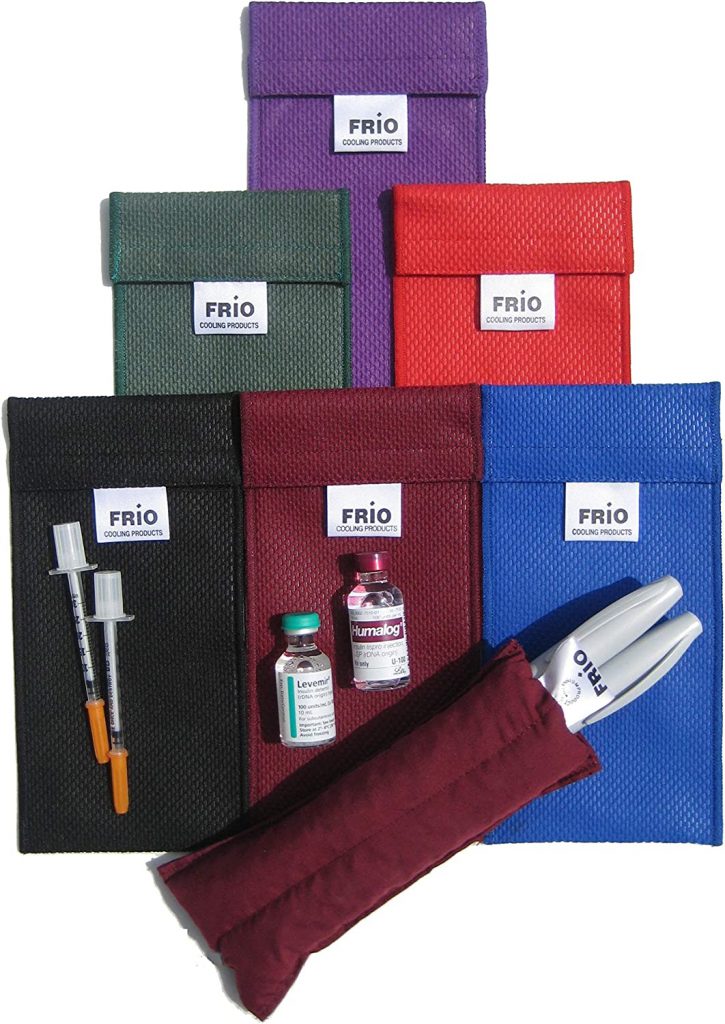
Frio Wallet (Insulin Cooler)
Insulated Tumbler
Insulated Tumbler with LED Temperature Display
Ice Packs

Blood Sugars

Every Type 1 Diabetic’s blood glucose levels respond differently while swimming at the pool. Variables that can effect blood sugar include water, water temperature, swimming, exercise, heat, excitement, adrenaline, etc. Be prepared for hypoglycemic (low), hyperglycemic (high) or blood sugars that stay in-range. Make adjustments to basal or I:C ratios based on the individual’s body and how it responds to exercise/water/heat.

Favorite supplies for managing low blood sugars while swimming at the pool:

Honey Minis (12 carbs)
Glucose SOS (15 carbs)
Maple Syrup Minis (26 carbs)
Maple Cream
(17 carbs)

Favorite protein bars that travel well in a swim/pool bag (helps to maintain blood sugars in range):


Protein Bar 20g
Protein Bar 10g
Protein Bar 21g

Hot Tubs

Being in hot water can cause insulin to be absorbed faster. For insulin pumps users other than OmniPod you will have to disconnect and store your pump. This can cause blood glucose levels to rise faster than expected due to not receiving basal insulin while in the hot tub.

Swimwear

The right swimwear can help with keeping Type 1 Diabetes medical devices stuck to the skin while swimming. Consider swimwear that covers the devices for extra protection; cannon balls, diving and jumping into the pool all add extra force onto CGM’s and pump site’s adhesive.

  • Swimwear options:
    • Swim Jammers – adding swim jammers under swim trunks can protect a CGM or pump site that is placed on the legs.
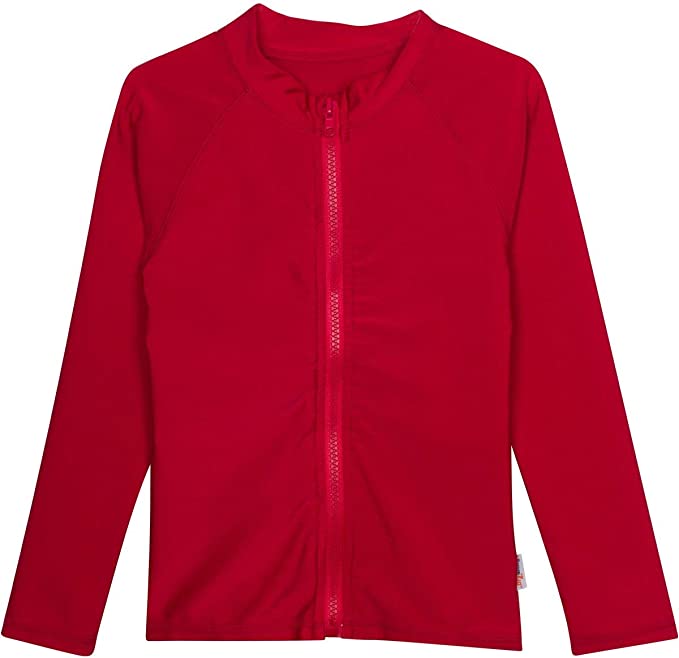
    • Rash Guard – a swim shirt or rash guard is helpful for avoiding sunburns and for protecting CGM or pump site that is placed on the stomach or arms.
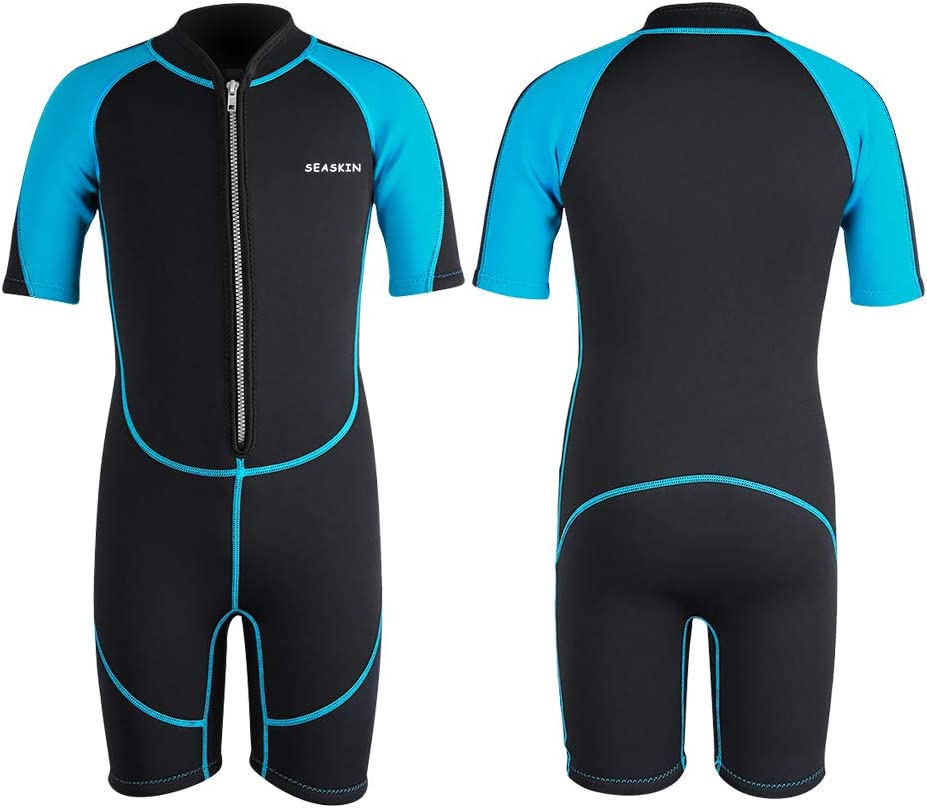
    • Wetsuit – a lightweight wetsuit (2mm) is comfortable to wear all day long, protects most CGM or pump sites all at one time and helps avoid sunburns.
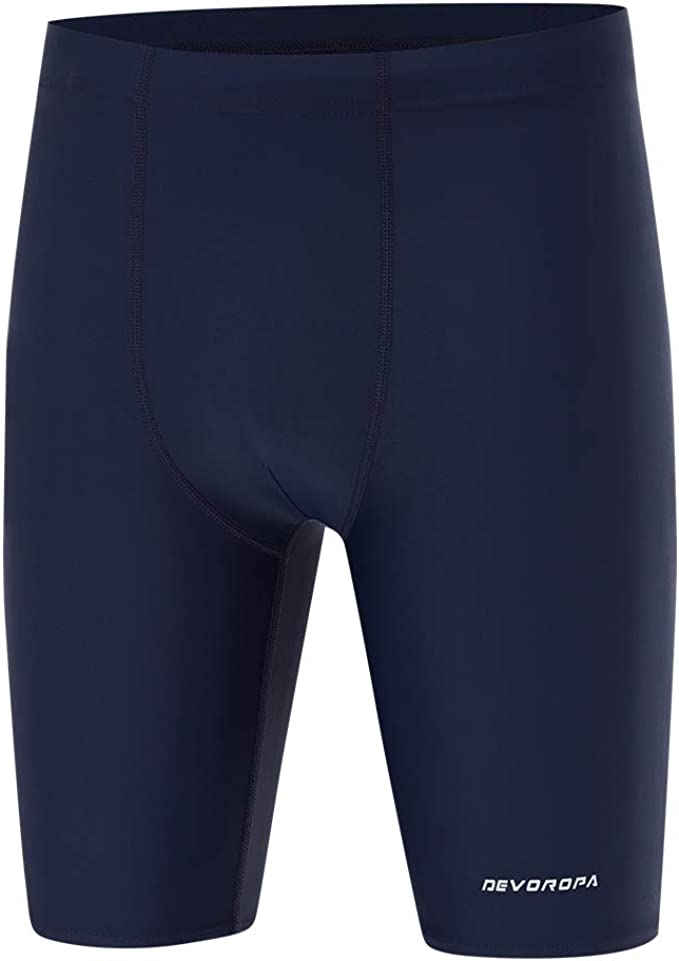
Swim Jammers
Rash Guard with Zipper
Lightweight Wetsuit (2mm)

Sunscreen

Keep your skin protected even at indoor pools. Sunburns can cause high blood glucose levels and ruin your fun. When applying sunscreen stay clear of medical device’s adhesive patches (sunscreen can make the adhesive malleable and device will just slide off) and OmniPod insulin pumps (sunscreen causes pods to crack/leak).


Famous People with Type 1 Diabetes (T1D)

Posted on August 9, 2022January 31, 2026 By Diabetes Amigo
Famous People with Type 1 Diabetes (T1D)
Day-to-Day T1D

Kids growing-up with Type 1 Diabetes (T1D) need to know that they can achieve anything. Listed are individuals living with T1D that have achieved amazing accomplishments and/or fame.

Insulin Famous / Famous T1Ds / Cinema with T1D

Insulin Famous

Individuals that have made a difference by using or making insulin.

Frederick Banting – awarded the Nobel Prize in Physiology or Medicine for his work with insulin
Leonard Thompson – the first person treated with insulin
Eva Saxl – self-taught manufacturer of insulin during World War 2
Elizabeth H. Gossett – first American to be treated with insulin

Famous Type 1 Diabetics

Wikipedia has a comprehensive list of public figures, athletes, Olympians, actors, singers/musicians, doctors , authors, etc. with T1D. Rather than recreate the list, I have linked it here. I encourage you to add to the list if you find a person that is missing.

List of Films, Movies and TV Shows with Type 1 Diabetic Characters

Another interesting list on Wikipedia is films/TV shows that include a character with diabetes. Sometimes the filmmakers get Type 1 Diabetes symptoms, medical devices and treatment wrong but it is always nice to see T1D represented on the big screen.

Skiing and Winter Sports with Type 1 Diabetes

Posted on April 4, 2022September 28, 2025 By Diabetes Amigo
Skiing and Winter Sports with Type 1 Diabetes
Day-to-Day T1D

Hitting the slopes to ski or playing in snow requires a few considerations with Type 1 Diabetes.

Blood Sugars / Supply Bag / ID / Lifts / Hydration / Gear / Communication / Organizations

This post may contain affiliate links. Please see the affiliate disclosure for more details.

Blood Sugars on the Slopes and in Snow

Every Type 1 Diabetic responds differently to cold weather, altitude, and exercise on the slopes/snow. Be prepared for hypoglycemic (low), hyperglycemic (high) or blood sugars that stay in-range. Make adjustments to basal or I:C ratios based on your body and how it responds to exercise.

Before our first trip to the snow, I read many posts about kids going low in snow/cold. I decreased basal and gave uncovered carbs before hitting the slopes. Well…my kiddo stays completely in range while skiing and in cold weather. No changes to basal or I:C ratios are necessary and I spent 3 hours correcting high blood sugars. Every diabetic responds differently to snow/cold. Be prepared to with the right tools to manage blood sugars:

  • Lows
    • Ski jackets and ski pants typically have many pockets that are prefect for storing low treatments. Place you favorite fasting acting sugar low treatment in several pockets (glucose gel, hard candy and honey packs don’t freeze). Also include low treatments that help stabilize blood sugars (i.e., protein granola bar).
    • Consider keeping cash (coins and/or dollar bills for vending machines) in your pocket in case you need to purchase sugar to raise blood glucose levels.
Honey Minis
Gel
Protein Bars
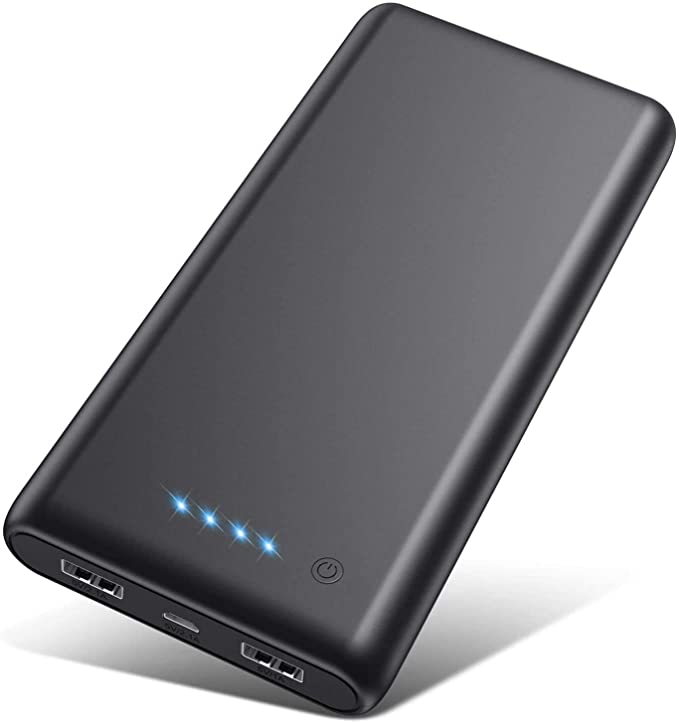
  • Power Bank
    • If using a CGM, consider having a backup phone charger/power bank. During intense exercise we find that we are checking numbers more often which can drain device batteries faster than normal.
Backup Phone Charger/Power Bank
  • Pumps
    • Altitude can affect blood sugars and insulin pump functionality. Read your pump’s manual for high altitude considerations.
  • Altitude
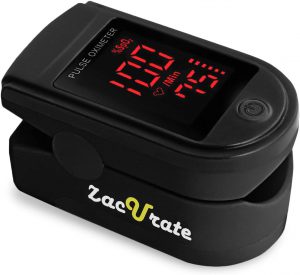
    • To avoid altitude sickness, stay hydrated and check oxygen levels. We keep an oximeter and cans of oxygen in our travel bag/sick day kit.

Oximeter Oxygen Saturation Monitor

Supplemental Oxygen

Daily Diabetic Supply Bag and Medical Devices

Type 1 Diabetic supplies don’t work well in extreme temperatures. Insulin, batteries, pumps, and phones can freeze during a day of skiing. A couple of options for your daily diabetic supplies and medical devices:

  • Lockers – most ski resorts offer indoor lockers for storing personal items. If you are at a small ski resort and can quickly get to your supplies, lockers are a great option for storing your T1D supplies. If skiing at a larger ski resort, keep in mind it could take over an hour to ski across the resort get back to your supplies in a locker.
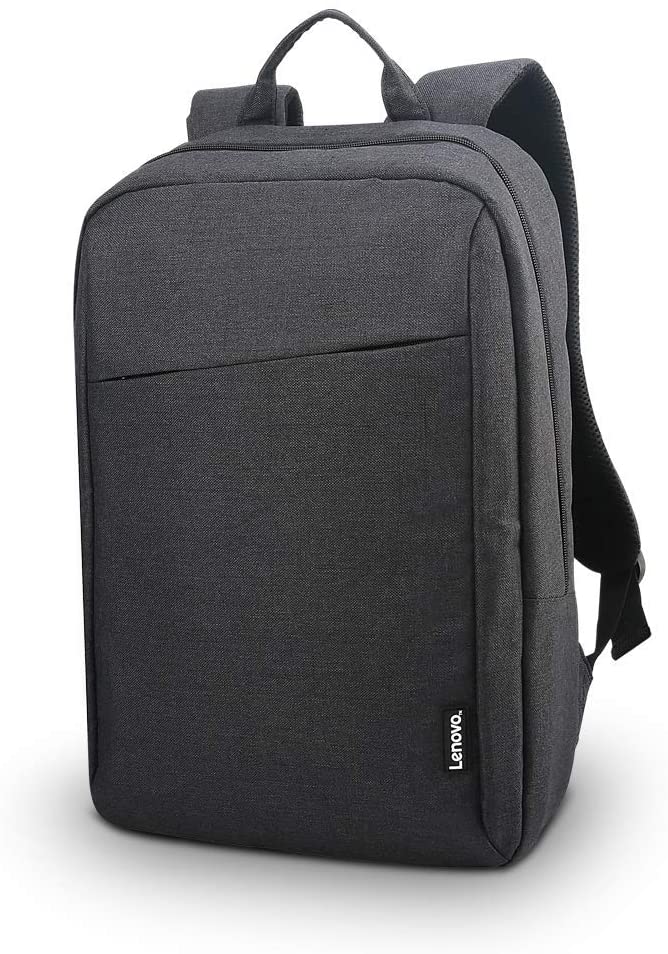
  • Backpack – a small, slim and streamlined backpack works best for keeping your supplies handy.
    • Place the diabetic supply bag inside the backpack closest to your body for warmth.
    • In extreme cold weather, the backpack can be worn under your ski jacket.
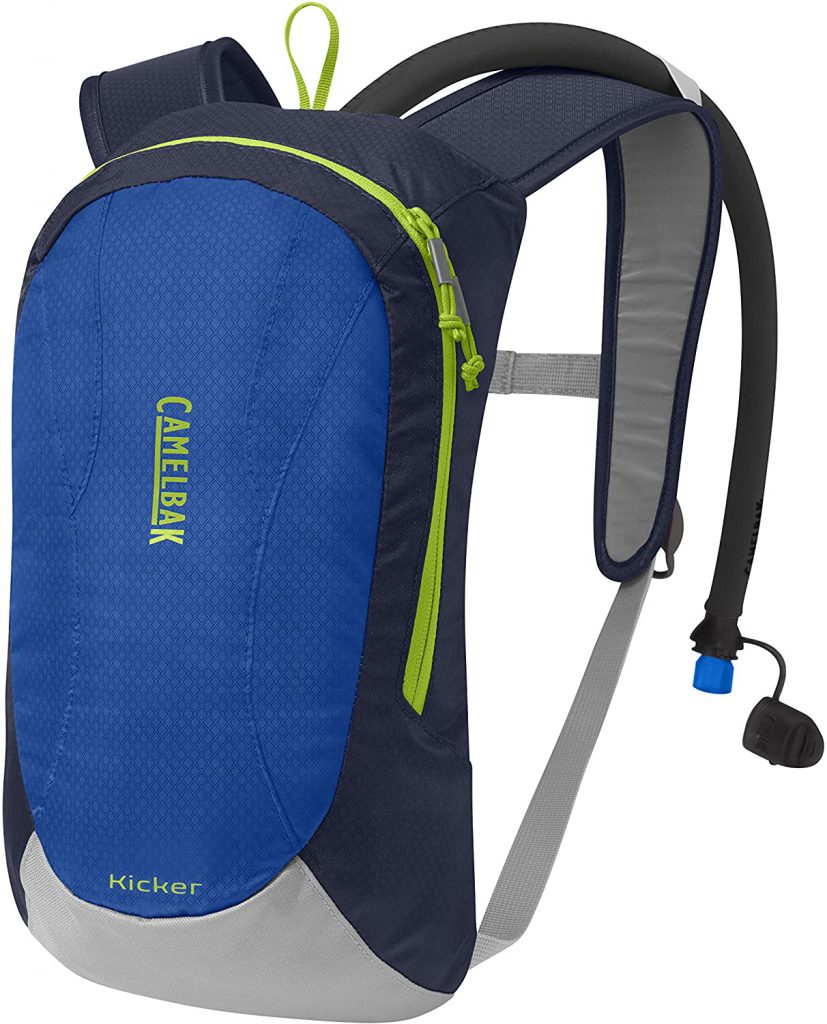
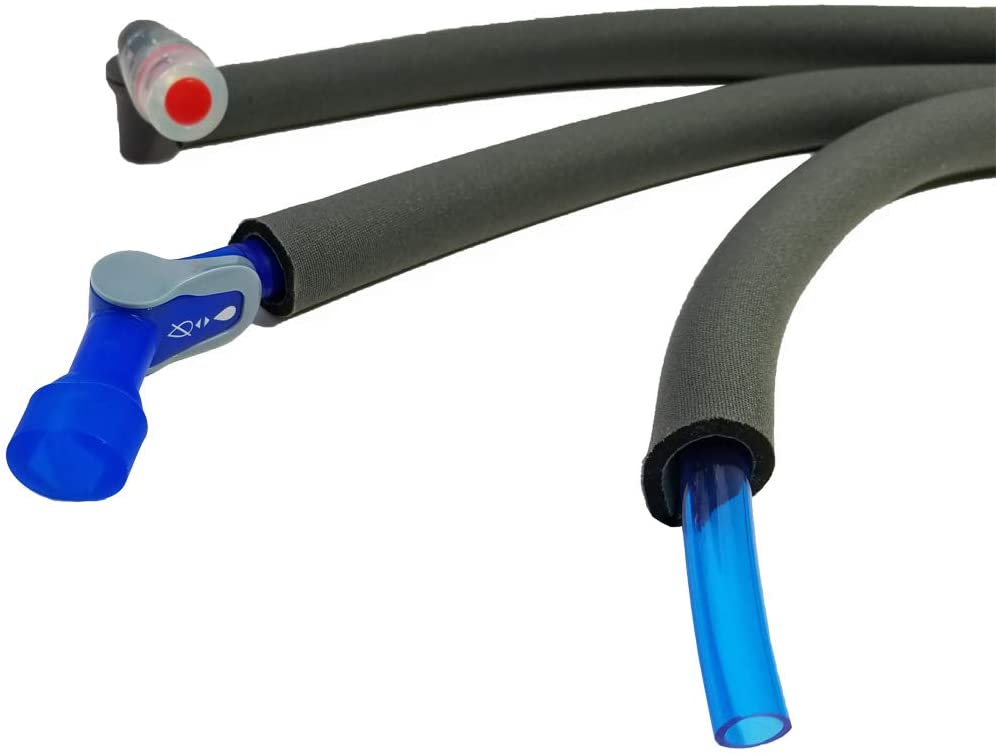
    • A backpack with a hydration pack/bladder for water is great for staying hydrated (hydration is necessary for Continuous Glucose Monitors [CGMs] accuracy). A neoprene cover is necessary to keep the water from freezing in the drinking tube.
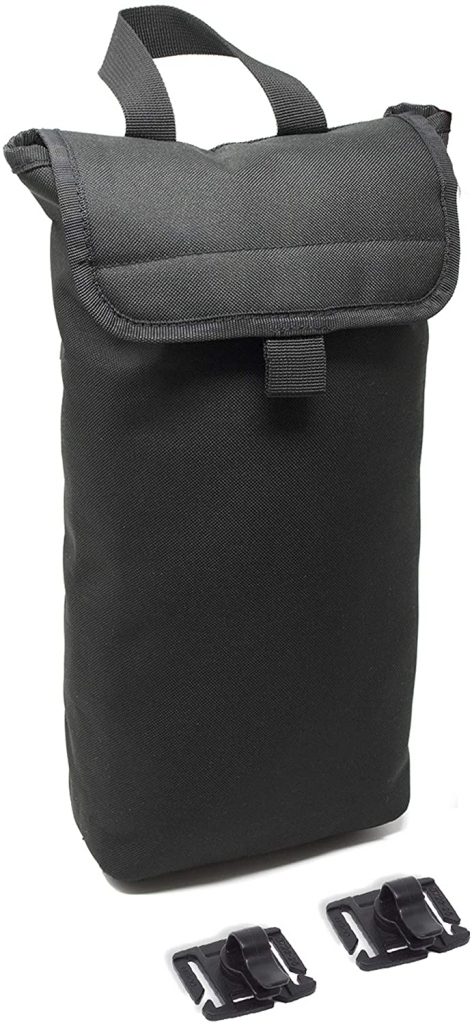
    • If using a hydration pack, consider a insulated bag the shape of the backpack for storing diabetic supplies to keep the backpack compact.
Ski Camelbak
Streamlined Backpack
Insulation pack
Neoprene Straw Cover
  • Pockets – if you prefer not to wear a backpack, ski gear has tons of pockets for storing your diabetic supplies. A ski jacket with inside zippered/Velcro pockets works best for storing T1D supplies.
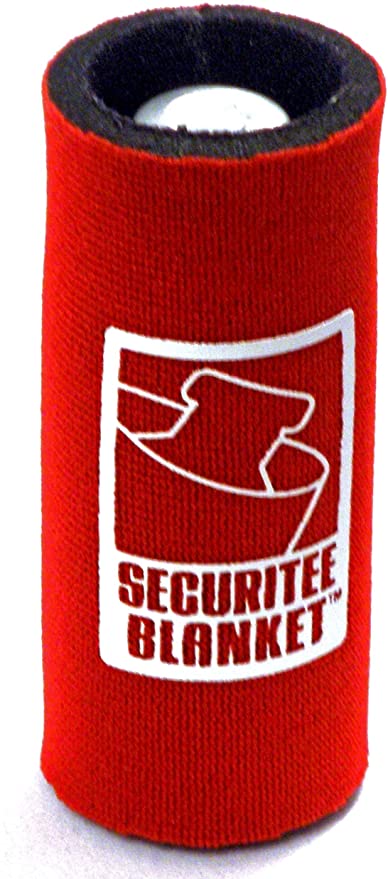
  • Insulin – protect a vial or pen of insulin from freezing by adding a sleeve (un-hydrated Frio bag or a neoprene sleeve).
FRIO Bag
Neoprene Pen Sleeve
Neoprene Vial Sleeve
  • Pumps – keep tubed pump tubing close to your skin to prevent it from freezing and tubeless pumps (OmniPod) typically does not need special considerations.
  • Phones, Batteries and Devices – if your glucose meter or phone start to have issues in the cold weather, consider using body heat to defrost (placing the device in your armpit and then pressing your arm against your body works well).
  • Medical Devices – bring spare CGM and pump supplies to the ski resort and store them in a locker or in your car.

Medical Identification

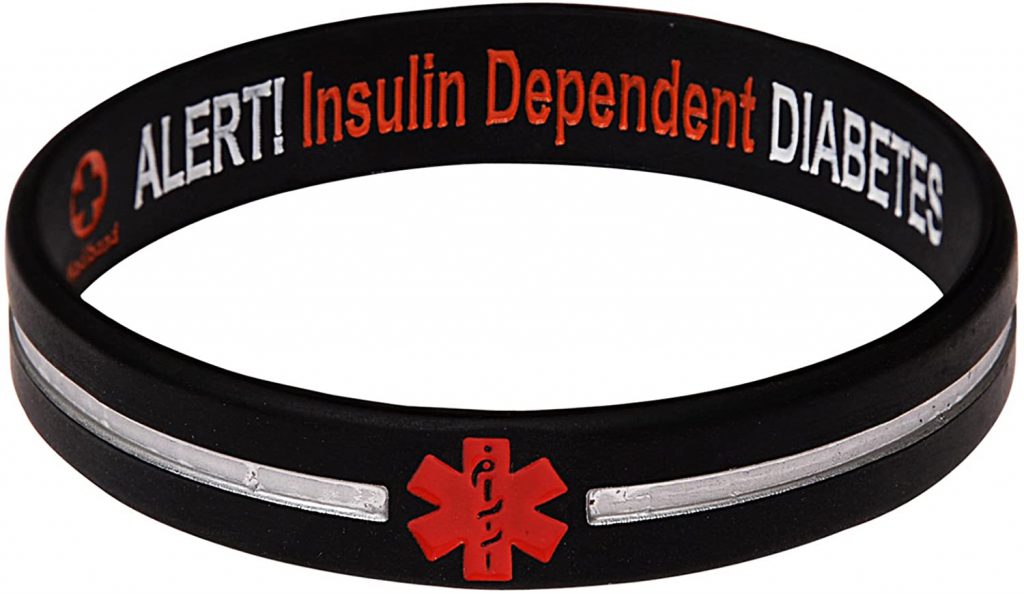
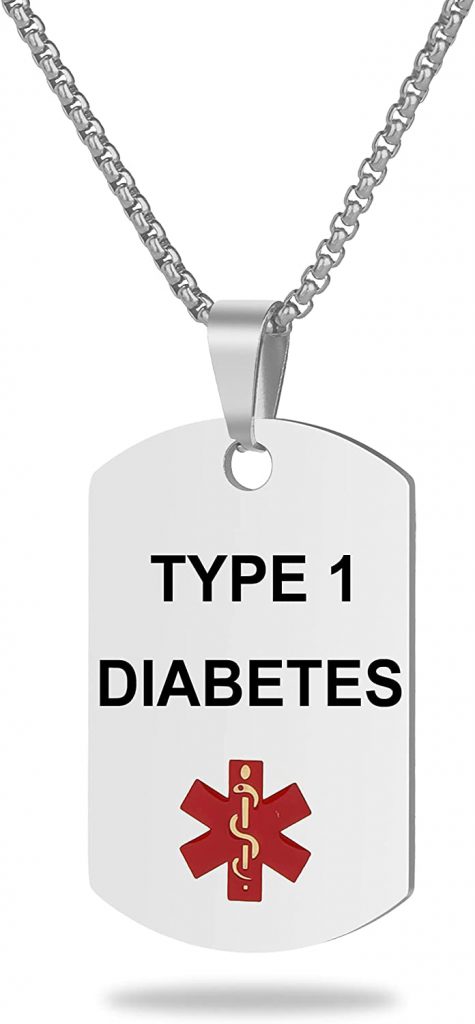
Wear your Medical ID bracelet or necklace that clearly denotes Type 1 Diabetes. In addition to a medical bracelet/necklace:

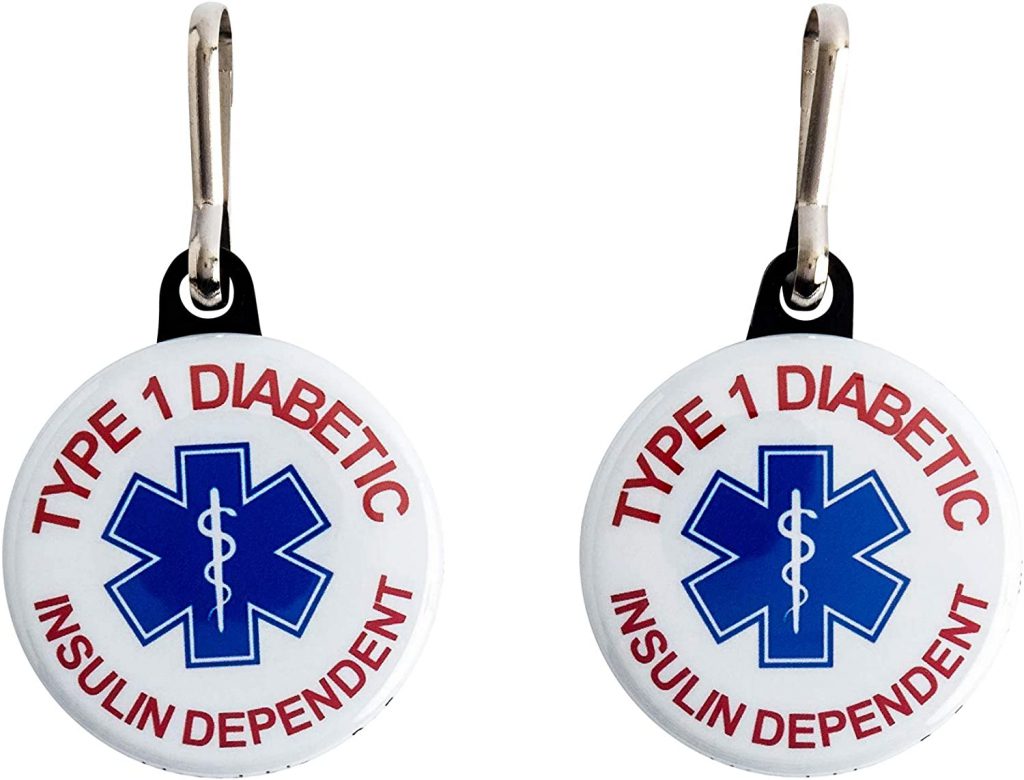
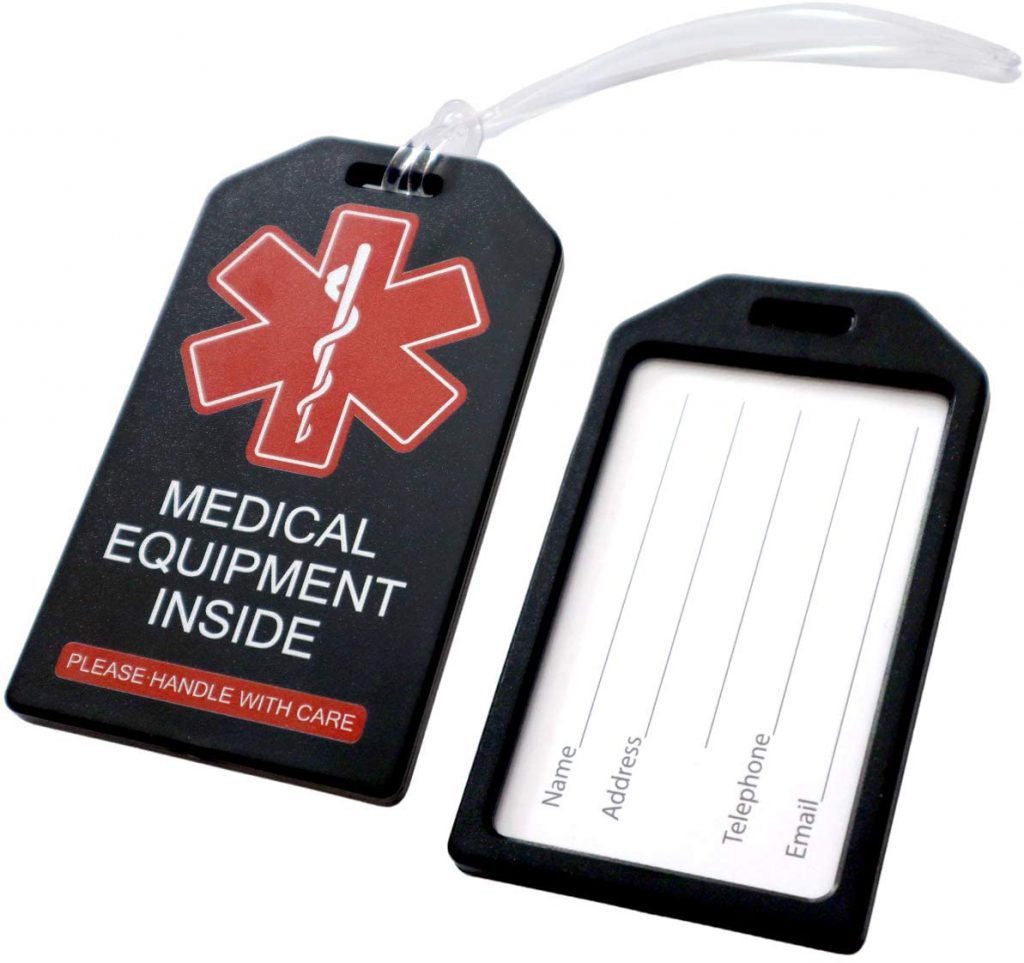
  • Tags – a T1D tag on your ski jacket zipper pull or backpack is also a great way to identify as Type 1 Diabetic.
Zipper Pull
Medical ID Bracelet
Medical Necklace
Backpack Tag
  • Ski Pass or Ski Ticket – use the back of pass to communicate emergency contact information and Type 1 Diabetic Insulin Dependent (we use a colorful sticker). It is not guaranteed that Ski Patrol will check your ski pass, but this additional identification could be helpful in an emergency.
  • Contact Ski Patrol and/or the ski resort – inform the resort that a Type 1 Diabetic is skiing the mountain. Most ski resorts have email and/or social media accounts. In your communication include:
    • For kids, take a picture in full ski gear and another without the gear.
    • Signs of low blood sugar flyer as a quick training on T1D. Also note that a T1D with a low blood sugar can appear drunk (helpful note to include for teenagers).

Lifts

Check your CGM or periodically manually test your BG before getting on a lift. Fumbling with phones, glucose meters, low supplies and/or a backpack on the lift is not ideal. On a lift, supplies could drop to the ground when taken out. Most areas under a lift are not accessible, making retrieval of dropped items difficult.

Hydration

Skiing is an intense sport done typically at high altitude which puts T1Ds at greater risk of dehydration. Be mindful of the water consumption while on the slopes. CGM performance could also be hindered if you are not hydrated.

  • To stay hydrated consider wearing a backpack with a hydration pack/bladder. A neoprene cover for the tubing is necessary to keep the water from freezing.
Ski Camelbak
Neoprene Straw Cover

Gear

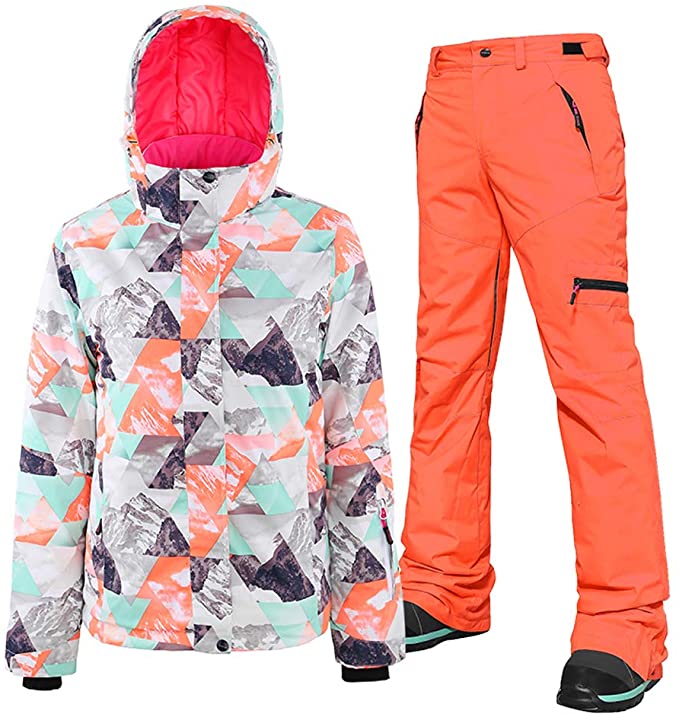
Ski jackets and pants typically have lots of pockets with zippers/Velcro closures that keep supplies easily accessible. Some other ski gear that works well to for T1Ds:

  • Bright Gear – for kids buy the brightest gear you can find. Everyone wears black and to quickly find your kid a white helmet or bright jacket/pants is easier to spot on the slopes. Ebay, Costco and Kohls are affordable sites to find ski gear.
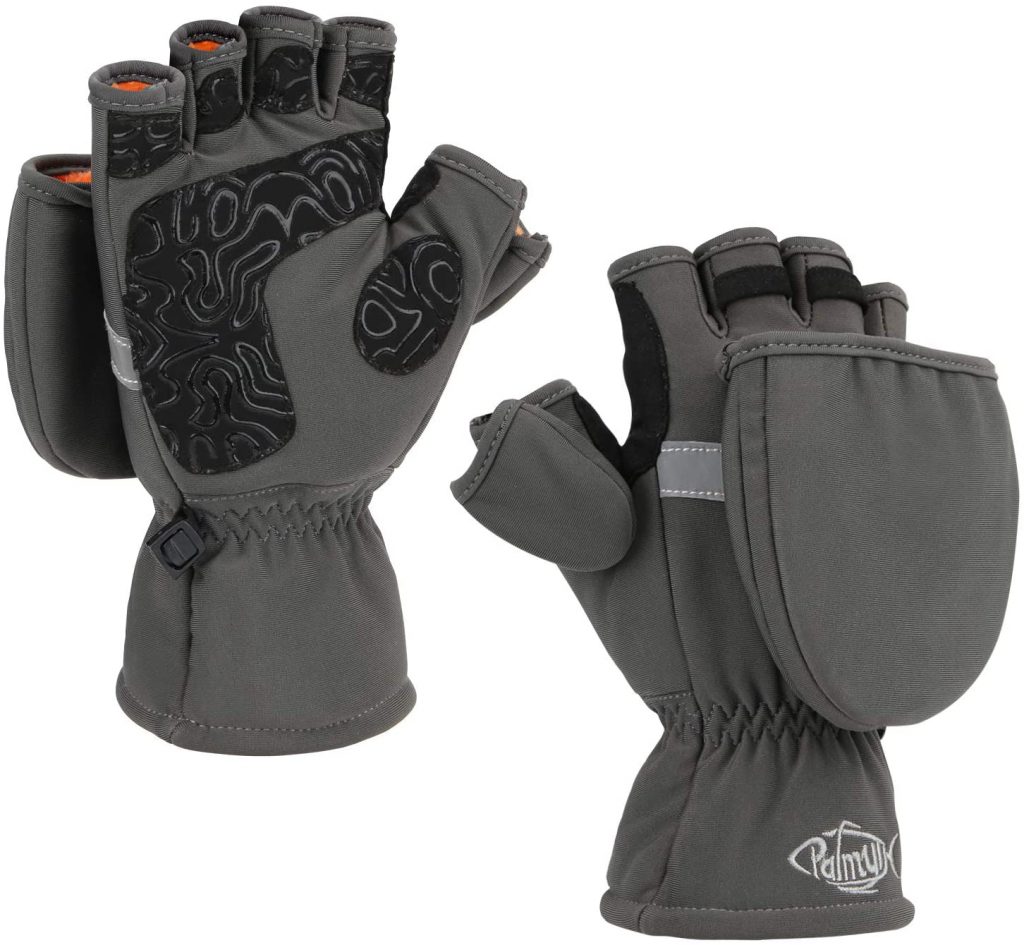
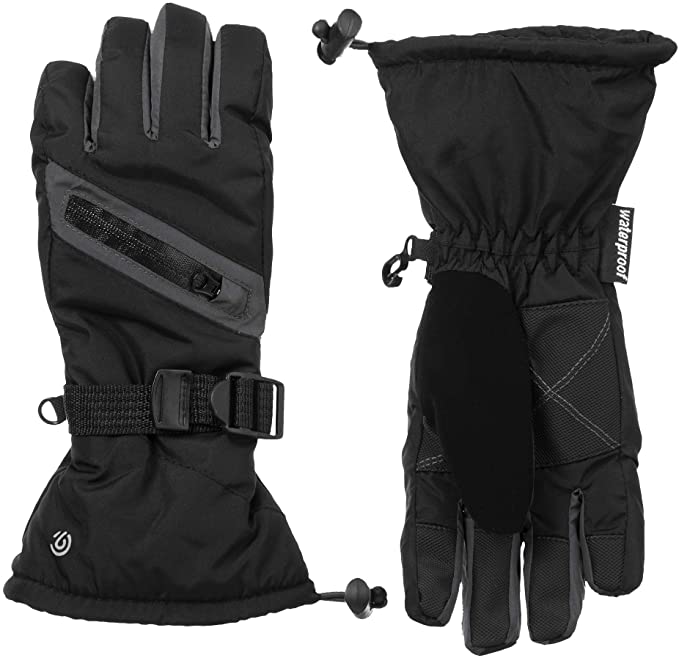
  • Gloves – gloves with pockets works well for low supplies and/or for hand warmer inserts. Also, convertible gloves allow easy access to fingers for bg testing.
Convertible Gloves
Kid’s Gloves with Pocket
Hand Warmers
Bright Ski Gear

Have a Communication Plan

We typically ski as a family, but my kids are fast going down the slopes! In case we get separated, we talk every morning about the “communication plan” that includes what to do when there is no cell service.

  • For kids, write your name number on the back of their ski pass/ticket and/or inside their jacket (most kid ski jackets have a name label).
  • Determine a meeting place that serves as “home base” and instruct kids to stay in that location until found. If unable to get back to “home base,” we ask our kiddos to go to the nearest lift operator and inform the operator that they are lost.
  • For kids, daily take a picture in full ski gear and another without the gear.
  • Consider adding In Case of Emergency (ICE) settings to your phone.

Skiing Organizations for Type 1

Riding On Insulin – organization that empowers, activates and connects the global diabetes community through shared experience and action sports. 

Type 1 Diabetes Travel Packing Checklist

Posted on February 18, 2022February 21, 2022 By Diabetes Amigo
Type 1 Diabetes Travel Packing Checklist
Day-to-Day T1D

Traveling with Type 1 Diabetes (T1D) requires lots of supplies! Stay organized and prepared with the T1D Packing Checklist.

This post may contain affiliate links. Please see the affiliate disclosure for more details.

Checklist / Travel Bags / Supplies / Chargers / Adhesive / Water / Misc

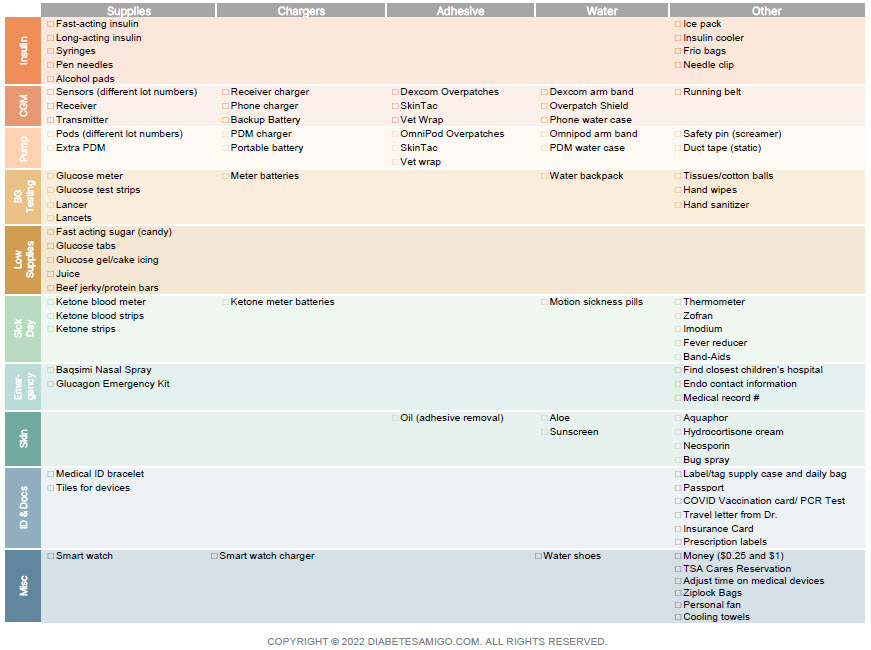
T1D Travel Packing Checklist

The Travel Packing Checklist is group by topics and provides a checklist for diabetic supplies, chargers, adhesive, considerations for water activities and other miscellaneous needs while on vacation. The quantity of supplies is not listed due to the number will vary based on your length of stay and type of travel. It is recommended to bring triple the amount of needed supplies.

Type-1-Diabetes-Travel-ChecklistDownload

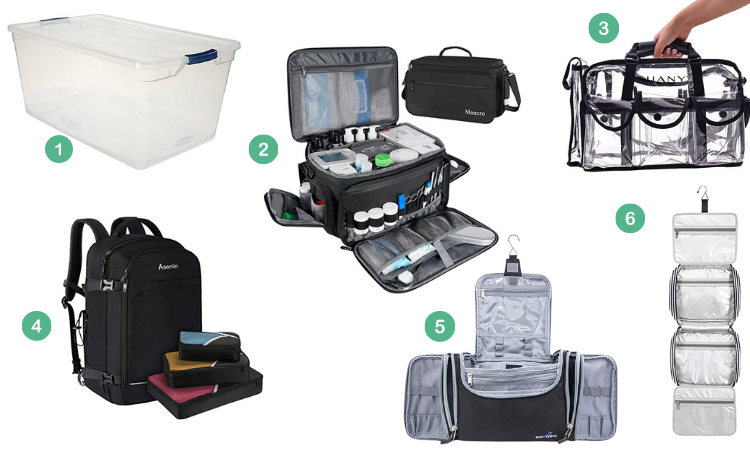
Travel Bags

  1. Storage Tote Bin – works well for road trips
  2. Medical Supply Bag
  3. Makeup bag
  4. Travel backpack with packing cubes
  5. Toiletry bag
  6. Hanging toiletry bag

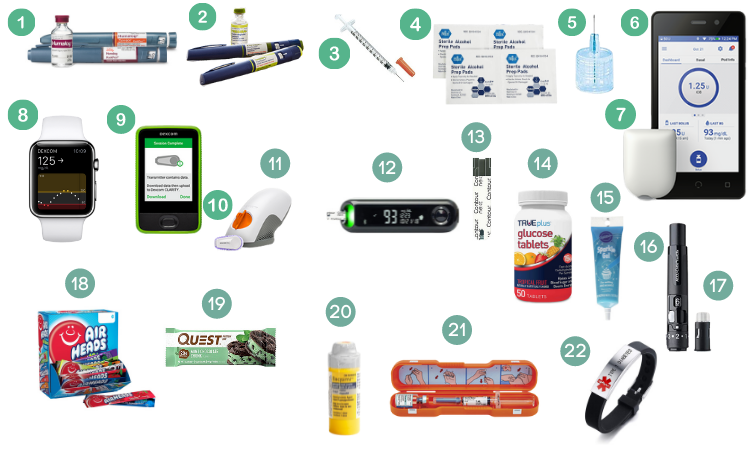
Supplies

  1. Fast-acting insulin
  2. Long-acting insulin (in case of pump failure)
  3. Syringes
  4. Alcohol pads
  5. Pen needles
  6. Extra PDM – contact OmniPod to request an extra PDM during travel
  7. OmniPod Pods
  1. Smart watch
  2. Dexcom receiver
  3. Dexcom transmitter
  4. CGM Sensors
  5. Glucose Meter
  6. Glucose test strips
  7. Glucose tabs
  8. Cake gel
  1. Lancer
  2. Lancets
  3. Fast acting carbs
  4. Protein bars
  5. BAQSIMI
  6. Glucagon Emergency Kit
  7. Medical ID bracelet

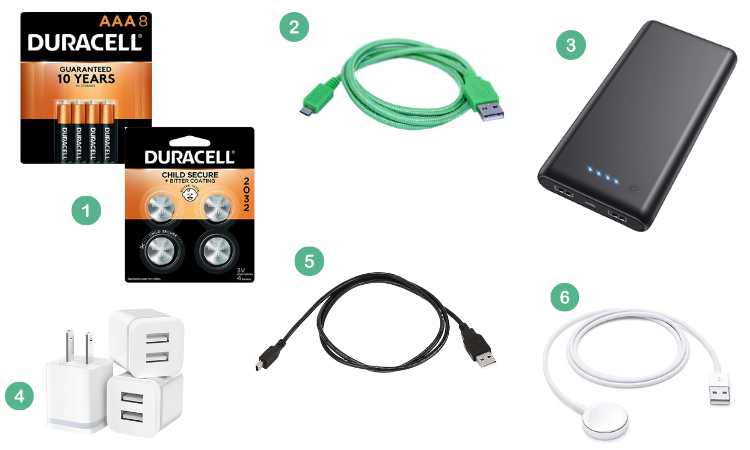
Chargers

  1. Batteries – for glucose/ketone meters (typically button battery) and Eros PDM (AAA)
  2. Dexcom receiver charging cord
  3. Portable charger
  4. Omnipod Dash PDM charging cord
  5. USB wall chargers
  6. Smart watch charger

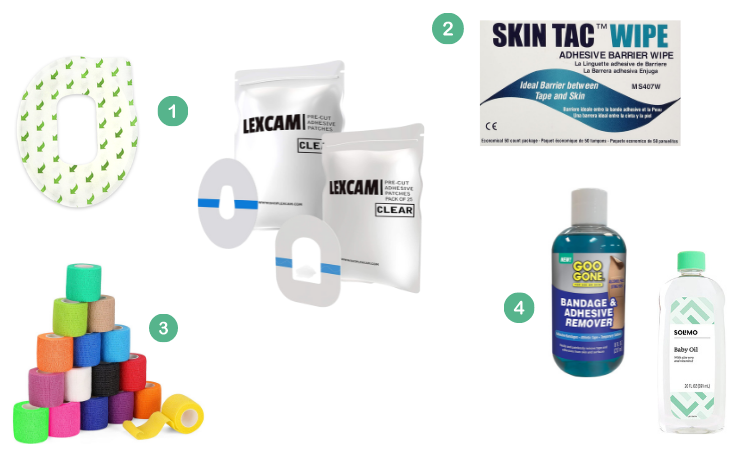
Extra Adhesive

  1. Overpatches – Free Dexcom overpatch, Lexcam Dexcom, Lexcam OmniPod
  2. SkinTac
  3. Vet wrap
  4. Adhesive remover – GooGone or baby oil

Water

  1. Dexcom band
  2. OmniPod band
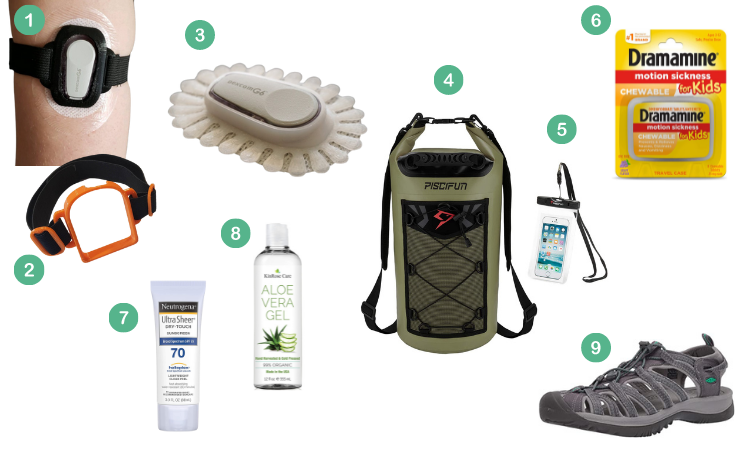
  3. Overpatch shield for Dexcom
  4. Dry bag
  5. Phone and PDM water case
  1. Motion sickness pills
  2. Sunscreen
  3. Aloe
  4. Water shoes

Misc Supplies

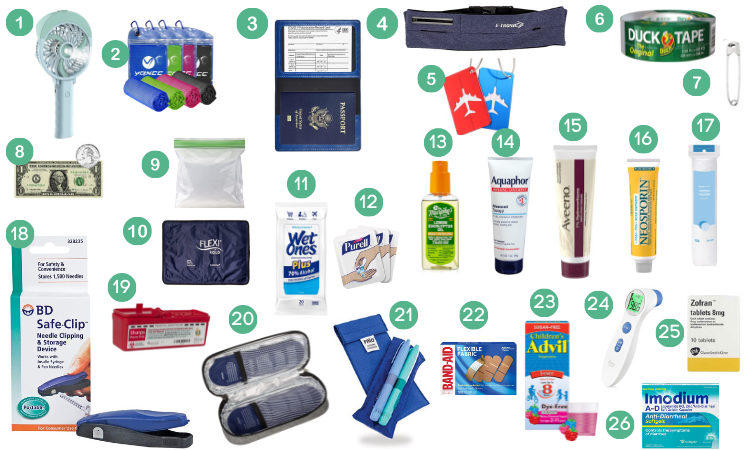
  1. Personal fan – heat can raise bgs
  2. Cooling towels
  3. Passport and Vaccination Card holder
  4. Running belt
  5. Contact information tags
  6. Duct tape – relives pod static issues
  7. Safety Pin – for Pod screamers
  8. Money – dollars and quarters (vending machine) to purchase low supplies
  1. Ziplock bags
  2. Reusable ice pack
  3. Hand wipes
  4. Hand sanitizer
  5. Bug spray
  6. Aquaphor
  7. Hydrocortisone
  8. Neosporin
  9. Cotton balls
  10. Needle clip
  1. Sharps disposal
  2. Insulin cooler – for warmer weather and beach days
  3. Frio bags
  4. Band-aids / first-aid kit
  5. Fever Reducer
  6. Thermometer
  7. Zofran (generic Osterdan) or Ipecacuanha (homeopathic)
  8. Imodium

Comments?

Anything missing from the checklist? Do know of a product the makes T1D travel easier? If so, leave a comment below.

Tips for Measuring Food for Carb Counts

Posted on April 20, 2021January 4, 2022 By Diabetes Amigo
Tips for Measuring Food for Carb Counts
Day-to-Day T1D

Every carbohydrate counts for my child’s blood sugar to stay in range. Detailed are tips for measuring carbohydrates to obtain accurate carbohydrate counts.

Types of Measuring Cups / How to Measure / Measuring on the Go

Types of Measuring Cups

It is important to use the right measuring tool to accurately measure ingredients to get an accurate carb count. The type of measuring tool used is based on if the ingredient is wet or dry. If a wet measuring cup is used to measure dry ingredients the measurement will be incorrect and might result in an undesired blood sugar high/low.

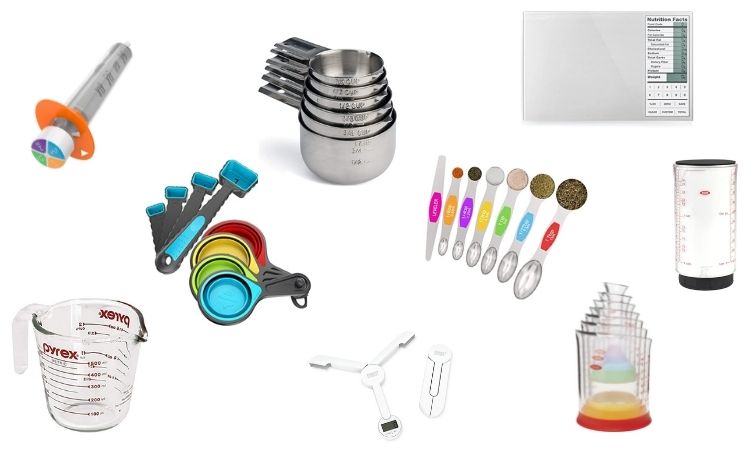
  • Wet – used to measure liquids. Measure items like juice, milk, or applesauce.
    • Pyrex set
  • Beaker – works great when measuring smaller liquid/wet amounts. Measure items like maple syrup, juice, or honey.
    • Nesting beakers
  • Sticky – perfect for measuring liquids that are more solid. Measure items like peanut butter, yogurt or honey.
    • Sticky measuring cup
  • Oral Syringe – helpful when measuring precise amounts of a wet ingredient to avoid over-treating a low. Also helpful for dispensing liquids into a sleeping child’s mouth. Measure items like maple syrup, juice, or cake gel.
    • Oral syringe
  • Dry – used to measure dry/non-liquid ingredients. Measure items like cereal, dried fruit, or nuts.
    • Dry measuring cups
    • Collapsing dry measuring cups
  • Measuring Spoons – smaller measuring tool that can measure wet or dry ingredients. Measure items like sugar, maple syrup, or glucose powder.
    • Measuring magnetic spoons
    • Collapsing measuring spoons
  • Food Scale – a food scale measures wet, dry or hard to measure ingredients. A food scale is helpful for measuring foods that do not fit perfectly into measuring tools. Most scales measure in ounces or grams and have a tare feature. The tare feature allows for subtracting the weight of the container holding the wet/dry ingredient. Also, look for a digital scale that has food codes for carb counts on common foods based on weight.
    • Perfect portions food scale
    • Smart food scale

How to Measure Carbs

  • Wet Ingredients – using a flat surface, add the liquid to the desired measure marking. Wait for the liquid to stay still, move your eyes to the same level as the measuring cup and make sure liquid level is at the desired mark (align the bottom of the curved surface [called a meniscus] with the markings on the measuring cup).
  • Dry Ingredients – spoon/scoop ingredients into the measuring cup. Level off the top of the measuring cup with the back of a knife or other flat surface.
  • Measuring Spoons – scoop ingredients into the measuring spoon. Level off the top of the measuring spoon with the back of a knife or other flat surface.
  • Food Scale – every scale is different so refer to your scale’s manual. Most scales:
    1. Turn on the scale.
    2. Choose the gram or ounces option (look at the food’s nutritional label to determine which option to choose).
    3. If using a container place the cup/bowl/plate on the scale and tare the weight of the container.
    4. Place/pour/scoop/spoon the ingredient into the container or place the food directly on the scale.
    5. Calculate the carbohydrates based on the weight of the food item and the nutritional label serving size information.

Measuring Carbs when Traveling

Products that I have found that work best when traveling to count carbs:

  • Folding food scale
  • Collapsible measuring cups/spoons
  • Water bottle with ounce markings
  • Calorie King book provides carb counts for most food items including restaurants/fast food

Decorating OmniPod Pods

Posted on April 3, 2021August 5, 2022 By Diabetes Amigo
Decorating OmniPod Pods
Day-to-Day T1D

This post may contain affiliate links. Please see the affiliate disclosure for more details.

If you like to show off your OmniPod (or maybe would like to not hear “what is that on your arm?”), decorate your pod! Keep in mind that some decorating techniques also help reduce pod static failures.

Decorating Tips / Products / Storage

Decorating Techniques

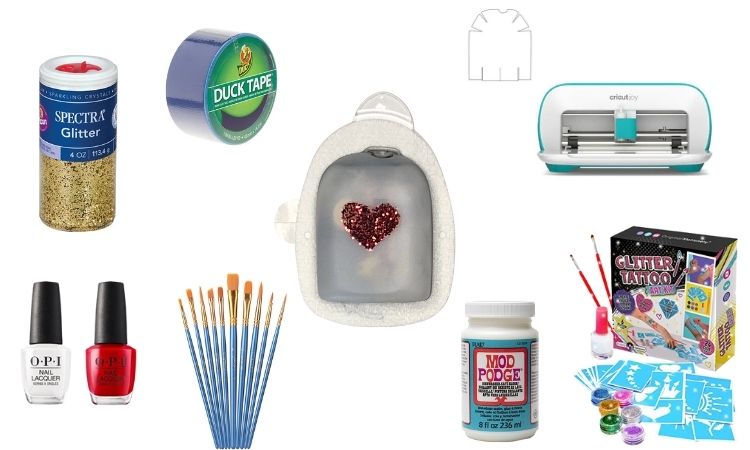
  • Duct Tape – cover an entire pod (excluding the adhesive) with duct tape. Consider buying duct etape that has preprinted colors, designs and cartoon characters to decorate the pod.
    • Duct Tape / Colored Duct Tape / Patterned Duct Tape
    • Gorilla Tape
  • Nail Polish – cover an entire pod (excluding the adhesive) with nail polish for a solid color or create nail polish art with several colors. Finish the design with clear nail polish or mod podge to seal the design.
    • Nail polish art set
    • Nail polish pens
    • Clear nail polish
    • Mod podge
  • Stickers with a Clear Coat – find your favorite design in a sticker, adhere it to OmniPod and then apply clear nail polish or mod podge to seal the sticker.
    • Make your own stickers
    • Print your own stickers
    • Sticker Book with 1000 stickers
    • Clear nail polish
    • Mod podge
  • Temporary Tattoos – apply a temporary tattoo (messages, art, cartoon characters and so on) according to the tattoo’s directions. Then apply clear nail polish or deco podge to seal the tattoo.
    • Variety pack of tattoos
    • Tattoo glitter stencils
    • Make your own temporary tattoos
    • Clear nail polish
    • Mod podge
  • Glitter – cover a pod with clear nail polish or mod podge, before it dries sprinkle on glitter and then add another clear coat (clear nail polish or mod podge) to seal the glitter.
    • Glitter
    • Clear nail polish
    • Mod podge

Pod Products

Preprinted pod shaped stickers and covers are sold by various vendors.

  • T1 Decals – vinyl stickers that are shaped perfectly to fit OmniPod.
  • Pump Pleelz – vinyl stickers that are shaped perfectly to fit OmniPod.
  • Shapeways – reusable OmniPod covers that cap on to the pod.
  • PumpSuitCover – German company offering reusable pod covers.
  • Mused Mediums – reusable OmniPod covers that cap on to the pod. The company has a Facebook group Diabetes Omnipod/Dexcom/Libre Water Marbling displaying many of their designs.
  • Just Fly Design – Type 1 Mom that designs custom and unique pod covers and stickers for OmniPod and Dexcom.
  • Sugar Fam Color Your Diabetes – Dutch company offering reusable OmniPod covers that cap on to the pod.
  • OmniPod Snaps – reusable OmniPod covers that cap on to the pod.

Storing Decorated Pods

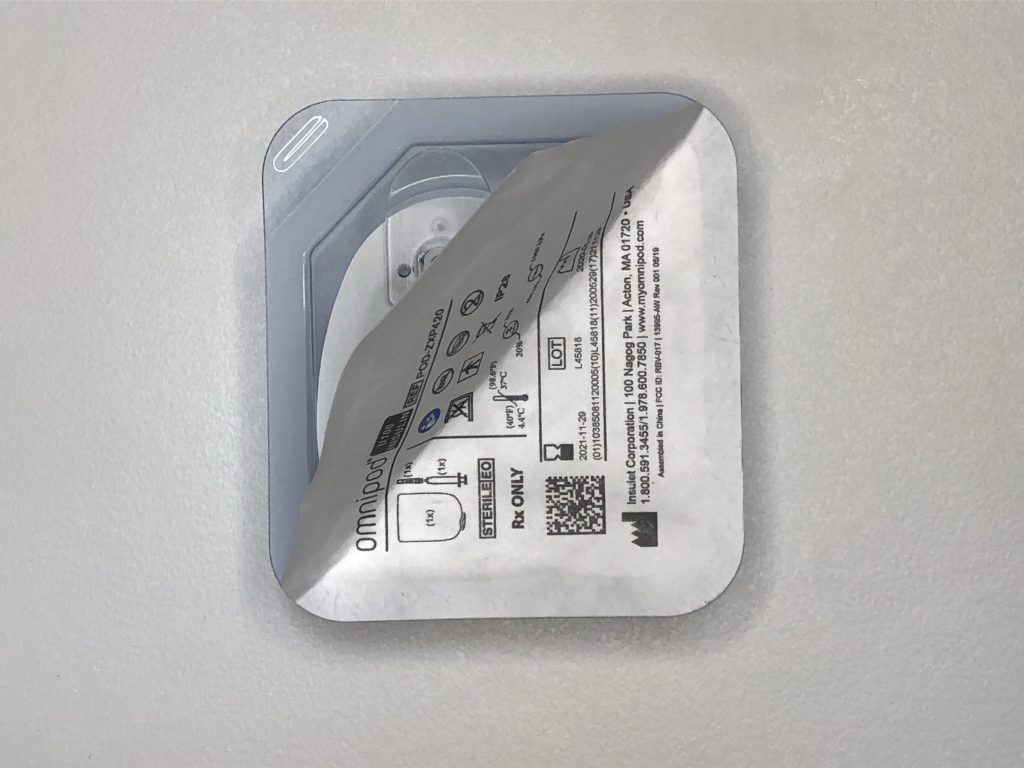
Keep the pod’s packing (paper seal, syringe, and plastic) to store the decorated pods. Lift the pod’s paper seal just enough to remove the pod. Decorate the pod, place the dry decorated pod back into the original packaging and tape the paper seal with scotch tape. Pods can then be placed back in the original box and stored.

Try to keep the pod, its packaging and box together for lot tracking purposes in case of pod failures.

Avoiding OmniPod Static Failures

Posted on February 24, 2021January 5, 2022 By Diabetes Amigo
Avoiding OmniPod Static Failures
Day-to-Day T1D

This post may contain affiliate links. Please see the affiliate disclosure for more details.

Static interfering with the performance of medical devices is frustrating and annoying. If an OmniPod pod is zapped with static it may result in a pod failure and cause the pod to alarm (referred to as a “screaming pod”). Detailed are ideas to help eliminate static failures.

Detecting Static Failures / Avoiding Static Tips / Products

Detecting Static Failures

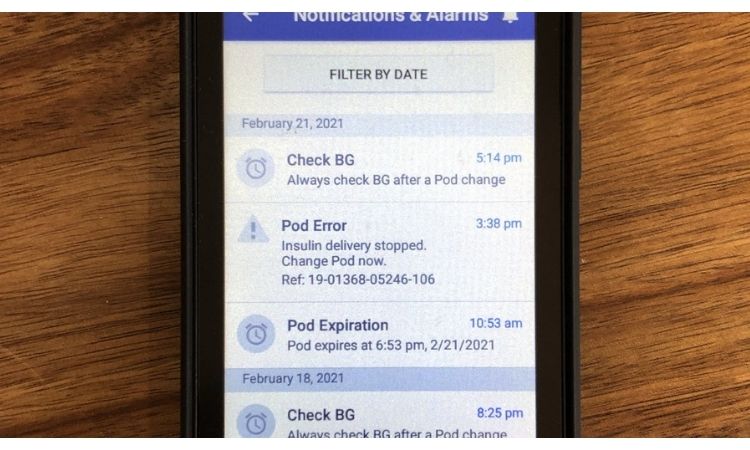
A pod that alarms and fails, keeps a reference of the failure in PDM settings. To determine if your pod failed due to static is achieved by calling OmniPod and providing the reference number of the failure to a Customer Care Representative. Keep in mind that OmniPod replaces failed pods free of charge (and will reimburse you for the cost of lost insulin).

To locate the reference code on the OmniPod Dash PDM, from the main menu choose the Notifications & Alarms menu option. Scroll to find the pod alarm notification with the reference code.

Avoiding Static Failures

  • Fabric Choices – Cotton clothes are a better choice to avoid static. Try to wear cotton closest to the device/skin and then layer with other fabrics. Fabrics like fleece, wool, nylon, synthetic and polyester attract static.
  • Static Guard Spray – Spray anti-static spray on clothing to help prevent static. Can also be sprayed on slides and other outdoor toys to eliminate static. You can make your own spray using equal parts liquid fabric softener and water in a spray bottle.
    • Static guard spray
    • Spray bottle
    • Liquid fabric softener
  • Duct Tape – Cover an entire pod with duct tape. Consider buying tape that has preprinted colors, designs and cartoon characters to decorate the pod.
    • Duct Tape / Colored Duct Tape / Patterned Duct Tape
    • Gorilla Tape
  • Nail Polish – Paint the entire pod (excluding the adhesive) with nail polish to help prevent static. Paint all one color or let your artistic side show.
    • Nail polish art set
    • Nail polish pens
  • Dryer Sheet – Rub or tape (cut to size) a dryer sheet directly on the pod to help prevent static. Consider keeping a dryer sheet inside the case of the OmniPod PDM or your diabetes kit.
  • Paper Clips – Wearing a paper clip close to the pod on your clothing helps to dissipate static. Some people prefer a safety pin to a paper clip.
  • Safety Pin – Wearing a safety pin on your clothes helps to dissipate static. Some people prefer wearing paper clip to a safety pin.
  • Lotion – Rubbing lotion on the OmniPod can help reduce static. Avoid lotion on the adhesive as it will act as an adhesive remover.
  • Humidifier – Adding a humidifier to your home lowers static electricity. If you don’t have a humidifier, you can boil water in a tea kettle or in a pot on the stove.

Products

  • Pump Pleelz – Vinyl stickers that are shaped perfectly to fit OmniPod.
  • Shapeways – Reusable OmniPod covers that cap on to the pod.
  • PumpSuitCover – German company offering reusable pod covers.

Donating Unused Supplies

Posted on February 14, 2021August 17, 2022 By Diabetes Amigo
Donating Unused Supplies
Day-to-Day T1D

This post may contain affiliate links. Please see my affiliate disclosure for more details.

Donating unused diabetic supplies is a fantastic way to help other diabetics.

Organizations / Other Ideas

Organizations

  • Insulin for Life – collects in-date & unneeded insulin, test strips, as well as other diabetes supplies, and ship them to developing countries. Donated supplies are distributed, free of charge, to children and adults with diabetes who otherwise would go without these lifesaving medications. To donate view:
    • Supply packing tips
    • Download the shipping form and label
  • CR3 Diabetes Association, Inc – collects supplies for people living with diabetes all over the world by providing knowledge, equipment and encouragement to those in need. To donate review their website for details.
    • Needed supplies and shipping information
  • SafeNexRx – provides affordable medication access to Iowans in need of assistance. Accepts sealed and unexpired lancets, syringes, needles, and glucose test trips.
    • Donation form and mailing address
  • Integrated Diabetes Services – collects many types of diabetes equipment and supplies (almost anything but lancets) to distribute by request to people with diabetes in the US and around the world.
    • To donate or request supplies, call 1-877-735-3648.
  • The Embrace Foundation – Diabetics helping Diabetics to send supplies to those who can’t obtain them. Donate supplies or complete a request form for T1D supplies.

Other Ideas

  • Dr’s Office – contact your Endo office to determine if they collect donated supplies.
  • Network – create your own network of individuals that could use your extra supplies by meeting them at local events like walks, Diabetes Camp, or Facebook groups.
  • Associations – contact your local JDRF or ADA associations.
  • T1D Rescue Warriors – Facebook group that helps Type 1 Diabetics find the insulin, diabetic supplies, referrals, and/or get questions and answers about hospitals and doctors in all towns across the world. 

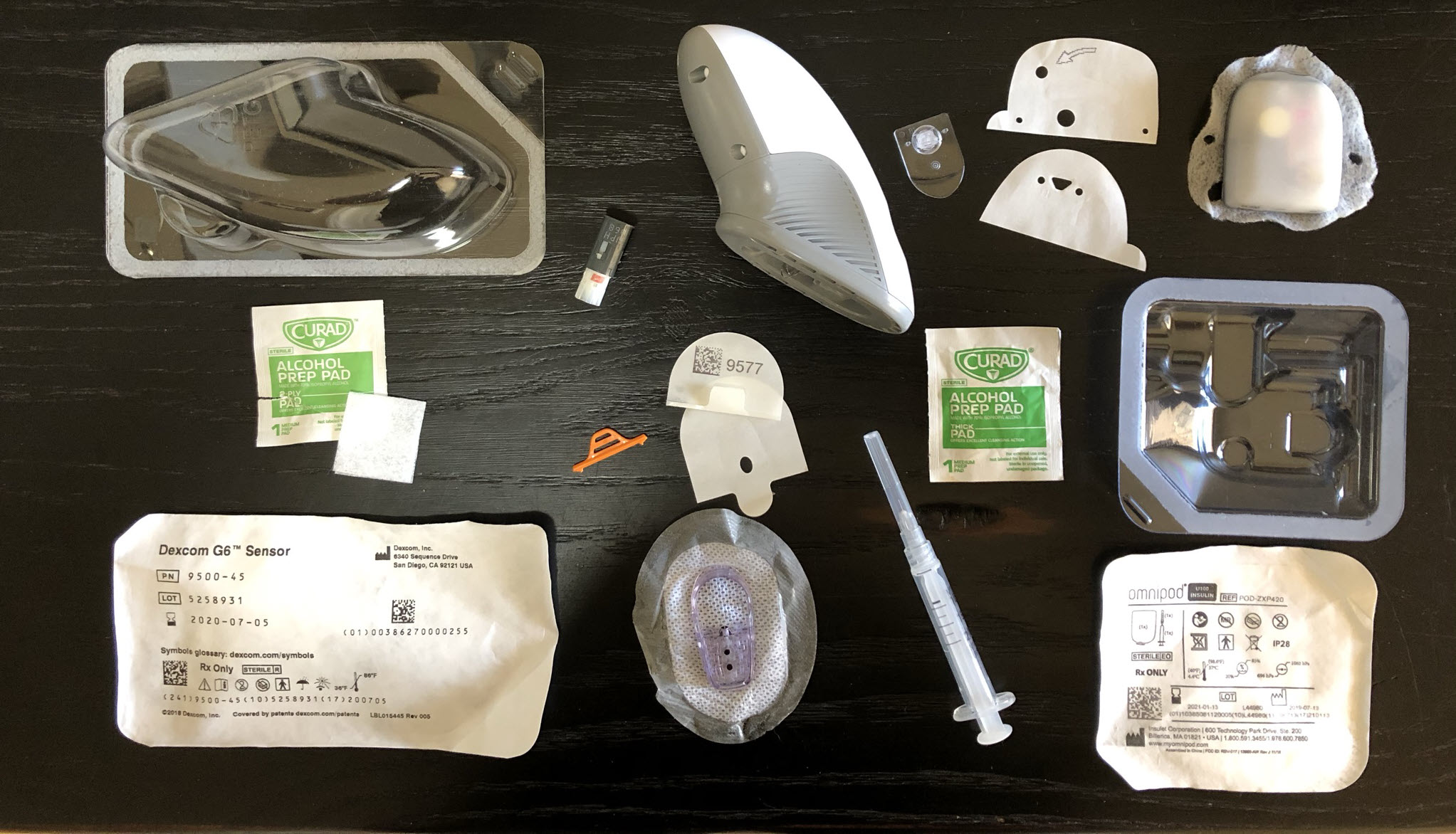
Diabetes Medical Waste Recycling and Disposal

Posted on November 8, 2020August 14, 2022 By Diabetes Amigo
Diabetes Medical Waste Recycling and Disposal
Day-to-Day T1D

This post may contain affiliate links. Please see my affiliate disclosure for more details.

Help reduce the environmental impact of Type 1 Diabetes management by knowing how to properly dispose of the medical waste produced.

The options for medical waste disposal varies by state. Check your states requirements and dispose of accordingly.

Waste Types / Sharps / CGM / Pumps / Travel

Waste Types

Regular, recyclable, medical/sharps and mixed waste are all present in diabetic supplies.

Look for a recycling symbol on test strip boxes, infusion set boxes, packaging inserts, plastic needle caps and dispose of in the recycling waste bin.

The options for medical/sharps waste disposal varies by state. Check your states requirements and dispose of accordingly.

Mixed waste can refer to any combination of different waste types. Typically medical devices like CGMs (Dexcom and Libre) and pumps like OmniPod are this type of waste. Call your trash/waste company to determine if they have a mixed waste disposal location or program.

Sharps

Here are few ideas from various states on how to dispose of your used sharps.

  • Sharps Container – purchase a sharps container with with or without return postage.
    • Sharps container with no return postage
    • Sharps container with return postage for disposal
  • Alternative Sharps Container – the FDA provides guidelines for medial waste disposal when not using a sharps container. The basics are to find a non-permeable container with a lid, label the container with “sharps” and fill it. When full, dispose of according to your state’s rules. Non-permeable container ideas include:
    • Juice bottle
    • Coffee creamer bottle
    • Laundry detergent bottle
  • Needle Clip – A needle clip eliminates the need for a sharps container for syringes and pen needles. Simply clip the needle and the needle clip retains the clipped needle. Once the needle clip is full (1500 needles), the entire device is disposed of according to state laws. Great for home use or when traveling.
    • BD Safe-Clip Needle Clipping and Storage Device
  • Endocrinologist – ask your Endo’s office if they assist in disposal of sharps.
  • Public Services – fire departments, police stations and/or your local hospital may offer disposal options.
  • Trash Company – call your trash/waste company to determine if they have a sharps and/or mixed waste disposal location.
  • Pharmacy – local pharmacies may offer drop-offs for sharps containers.
  • County Health Department – may offer sharps container exchange program (full container for an empty container).

CGMs

The Dexcom CGM G6 applicator is made of non recyclable plastic and is considered mixed waste (sharps, metal and regular waste). Check with your local trash/waste company to inquire about proper disposal for mixed waste. Used sensors can be placed in the Sharps container.

Dexcom’s G6 applicator can be broken down to separate the mixed waste. View a video on How to Recycle Your Dexcom G6 Inserter.

The Libre sensor pack is regular waste, the applicator is mixed waste and the used sensor should be disposed of in the sharps container.

Pump Site Changes

OmniPod – a used OmniPod is considered mixed-waste (sharps, plastic and batteries are all inside a pod). Insulet offers recycling of used pods for podders in Canada and the United Kingdom. The recycle program in the USA was retired in 2018. For podders in the USA, it is recommend to contact your local trash/waste company to inquire about proper disposal for mixed waste.

Look for recycling symbols on other pump infusion set and packaging and dispose of according.

Travel

When traveling, sharps containers can be found at airports, theme parks, first aid stations at large attractions and most hotels and cruise lines offer medical waste disposal container / services.

The needle clip or a travel sharps container / tube are great medical waste disposal options when traveling.

When proper waste management is not possible, we pack-up and bring home for disposal.


This post may contain affiliate links, which means if you click on a link and purchase something, I may earn a small commission (at no additional cost to you).

Diabetes Everyday Bag

Posted on January 28, 2020October 18, 2025 By Diabetes Amigo
Diabetes Everyday Bag
Day-to-Day T1D

This post may contain affiliate links. Please see the affiliate disclosure for more details.

Living with Type 1 diabetes means staying prepared for anything, from routine errands to unexpected adventures, and packing the right supplies in your Diabetes Everyday Bag ensures you have the all the supplies that you need to keep blood sugars in range.

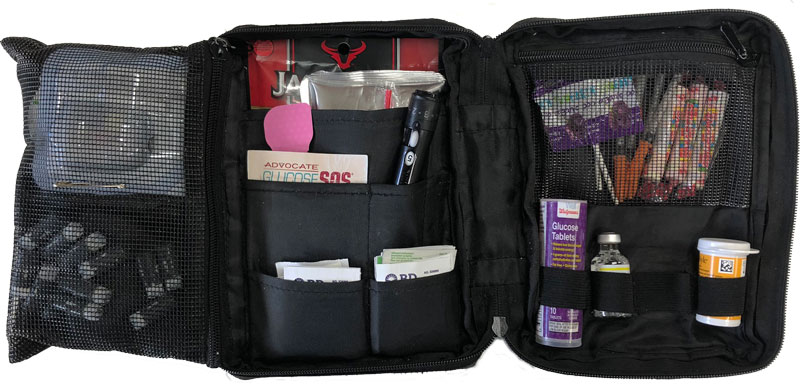
Diabetes Bag

The Medicol Dia-Pak Deluxe bag has been with us since the first week of diagnosis and has worked well for 5 years now. I needed a bag that could hold everything, switch easily between caregivers and have a cool-pack for travel. This bag holds all the Type 1 Diabetes (T1D) supplies and fits nicely in a diaper bag, purse, backpack or can be carried by itself (top handle or with the removable strap on a single arm or as a cross-body bag).

The bag comes in various sizes:

Keeping it Clean

Our daily diabetes bag gets dirty! The Dia-Pak bag floats around our house, travels everywhere with us, goes to school, attends play-dates, and then sits in my child’s room at night. I wash this bag on average once a month, in a regular laundry cycle, inside a mesh bag (to protect it) and then air dry. It has held up beautifully over the past 5 years.

Supplies

Cleaning out your bag also means restocking all the necessary diabetes supplies. Including replacing expired medication, food, batteries, and low supplies. Listed below are the contents that we keep in our D-bag daily.

  • Glucose Meter
    • We have the OmniPod PDM with the integrated glucose meter but we keep a spare meter in the kit just in case of malfunction (or if lost).
  • Glucose test strips
  • Lancer
    • Our go-to lancer is the Acc-Chek Fastclix
  • Lancets
    • We change the lancet with every finger poke (no kidding!) and find the Acc-Chek Fastclix lancet barrels the nicest option.
  • Syringes
    • Used for manual injections in case of pump failure and if the Glucagon syringe breaks.
  • Fast acting sugar
    • We keep an abundance of fast acting sugar options. When my toddler’s blood sugar is low, he can be picky. Our kit is loaded with low supplies:
      • Glucose Gel
      • Glucose Tabs
      • Glucose SOS
      • Suckers
      • Smarties
      • Juice
  • Baqsimi Nasal Spray
  • Glucagon Emergency Kit
    • I maintain a prescriptions for both the nasal spray and Glucagon medications because the Glucagon can be used in case of unconsciousness due to severe low blood sugar and during sick days (mini-glucagon shots to raise blood sugar).
  • Beef Jerky
    • Small pouches of beef jerky to use as protein snack after treating a low or as a low carb snack.
  • Insulin
  • Alcohol pads
    • Used for preparing skin for Dexcom CGM and OmniPod changes and if we need clean fingers when washing hands is not an option.
  • OmniPod Pod
    • Extra pod in case of pump failure.
  • OmniPod OverPatch
    • Lexcam – 20 waterproof patches that are pre-cut for Omnipod. Hypoallergenic and clear in color.
  • Safety Pin
    • Used to stop a screaming pod by puncturing the speaker.
  • Dexcom OverPatch
    • Free pack of 10 clear overpatches from Dexcom. Request when ordering supplies or order from the Patient Support Form. Enter “order overpatches” in the issue field.
  • SkinTac Wipe
  • Batteries
    • Backup batteries for the OmniPod PDM (AA batteries) and the spare glucose meter (2032 button battery).
  • Money
    • We keep a dollar in quarters and $2 in one dollar bills in case we need to buy a snack to treat low blood sugar when traveling or at school.
  • Contact Information
    • Clear insert that fits a business card or hand written contact information in case the kit is lost (not shown).

Extra Supplies Used on Long Trips

  • Dexcom – a spare Dexcom sensor and transmitter. For everyday trips/running errands, we are so close to home that I don’t find it necessary to have Dexcom backup supplies.
  • Portable Charger – a wireless battery powered phone charger helps when traveling in case our Dexcom phone’s battery goes low.
    • Battery powered portable charger
    • Solar powered portable charger
  • Frio Cooling Wallet – if activities include being out in the hot sun for long periods of time, the insulin vial is kept cool with a cooling wallet.
  • Straws – a travel toothbrush holder with straws. During naps or nighttime, treating a low with juice works best for my kiddo. Some juice bottles do not include straws. Also, the toothbrush holder is great for storing honey sticks.
  • Phone Dry Bag – if activities include water, a phone dry bag is helpful for cells phones, PDM or Dexcom receiver.

Posts pagination

1 2 Next
  • Instagram
  • Facebook

Copyright © 2026 Diabetes Amigo.

Theme: Oceanly News by ScriptsTown